Originally published July 27, 2010. Updated September 28, 2026.
Solar power costs $38 to $78 per megawatt-hour today, unsubsidized. A newly built US nuclear reactor costs $141 to $220 for the same unit of power, according to Lazard’s 2025 cost analysis. If your utility picks nuclear over solar for its next plant, that gap is most of what ends up in your rate case. Solar panels only run 20% to 30% of the time in a year, while nuclear reactors run closer to 90% of the time, so these two price tags aren’t measuring the same thing on their own.
What a megawatt-hour costs today
Lazard, the financial advisory firm that publishes the industry’s most closely watched cost benchmark, put out its 2025 unsubsidized cost report in June. The ranges below strip out every state and federal subsidy, so they show what it costs to build and run each kind of plant:
| Source | Unsubsidized cost per megawatt-hour |
|---|---|
| Onshore wind | $37 to $86 |
| Utility-scale solar | $38 to $78 |
| Solar plus battery storage | $50 to $131 |
| New-build nuclear | $141 to $220 |
Source: Lazard LCOE+, June 2025.
Solar and wind land in roughly the same range, both well under half of nuclear’s cost. Pairing solar with batteries costs more than solar alone, but even its top end, $131 per megawatt-hour, undercuts new nuclear’s low end by $10 per megawatt-hour. That’s the choice a utility faces on every new project, solar’s price or nuclear’s, for each megawatt-hour it puts on your line.
What EIA’s numbers show, and why they don’t match Lazard’s
The US Energy Information Administration publishes its own annual outlook, and its 2025 projections for plants entering service in 2030 show solar at $29.58 per megawatt-hour and a solar-plus-battery hybrid at $53.44. Advanced nuclear comes in at $81.45 in the same projections. Those numbers sit much closer together than Lazard’s, and that’s because they answer a different question.
EIA’s figures include federal tax credits from the Inflation Reduction Act, while Lazard’s strip every subsidy out. The EIA table shows what a developer might pay after credits. Lazard’s shows what a plant costs to build and run before any credits apply. Whether your utility bill ends up reflecting the subsidized number or the unsubsidized one depends on which of these two tables it used to plan the project.
What the last two US reactors cost
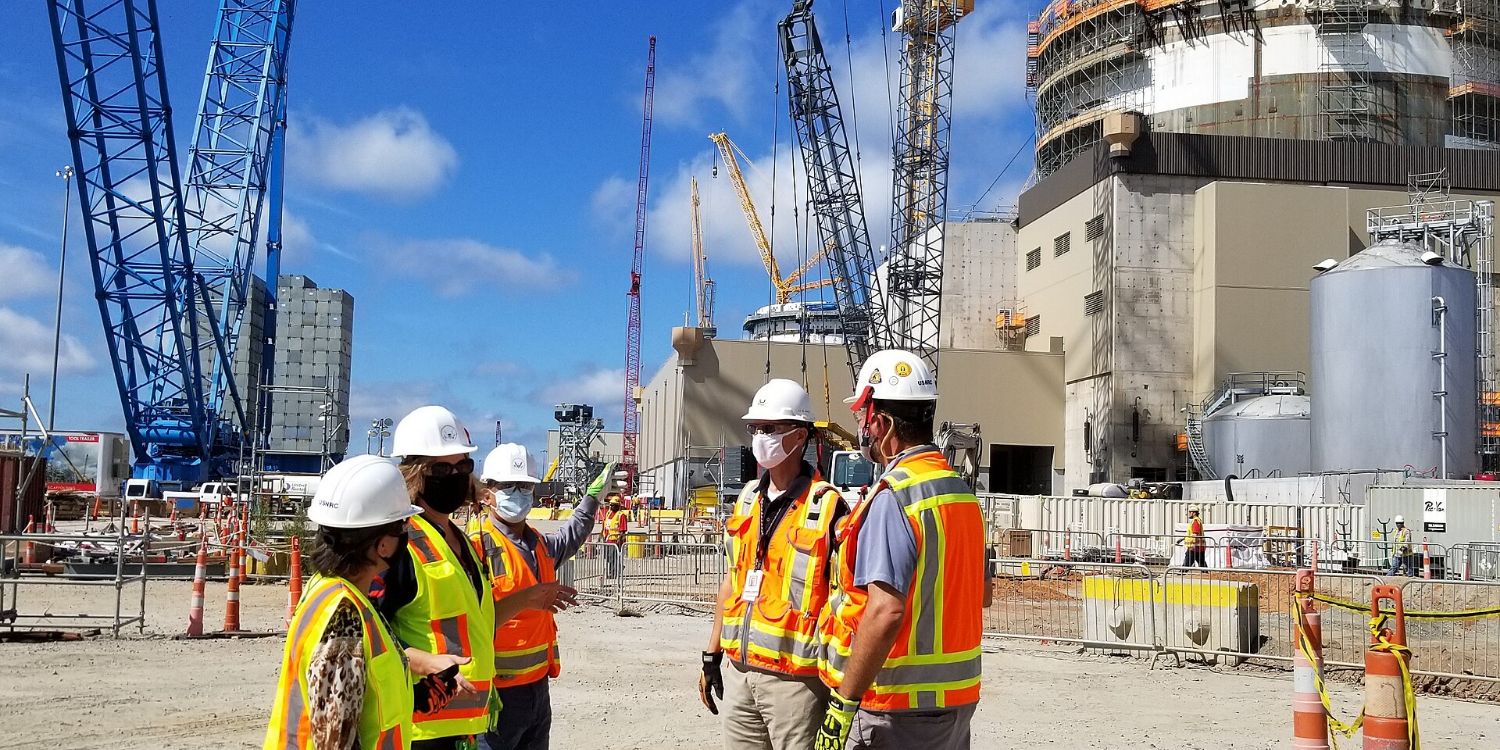
Lazard’s nuclear range is built on the only new US reactors completed in the past three decades, Vogtle Units 3 and 4 in Georgia. The project’s budget was $14 billion, targeting service around 2017. Instead, the first reactor started producing power in mid-2023, and the second followed in April 2024. Both arrived six to seven years behind the original target.
The project’s total cost passed $31 billion. Add Westinghouse’s $3.7 billion settlement for walking away from the build, and the running total climbs to about $35 billion. Lazard’s nuclear range assumes a follow-on reactor gets a 30% cost discount from lessons learned on Vogtle, spread over a 70-year operating life. Skip that assumption, and a new reactor built today would likely cost even more than Lazard’s range already shows.
Why cost per megawatt-hour isn’t the whole story
A megawatt-hour of solar and a megawatt-hour of nuclear aren’t delivered the same way. Lazard assumes utility-scale solar runs at a 20% to 30% capacity factor. New nuclear runs at 89% to 92%.
If you flip a light switch after dark, something other than a solar panel is keeping the current flowing, because panels stop producing the moment the sun goes down. That gap is what the industry calls capacity factor, and it’s the reason a cost-per-megawatt-hour number can’t stand alone.
Pairing panels with battery storage is how a solar plant keeps delivering power after dark, and that added equipment is a large part of why the storage line in Lazard’s table, $50 to $131 per megawatt-hour, costs more than solar by itself. Storage still costs less than new nuclear at either end of the range. None of these levelized-cost figures capture the extra grid costs, like backup capacity and transmission upgrades, that show up once solar makes up a large share of what one grid delivers.
The 2010 Duke study that started this argument
This question isn’t new. In July 2010, Energy Collective writer Osha Davidson covered a Duke University economist’s finding that solar had crossed nuclear on price in North Carolina.
Duke economist John Blackburn’s study, commissioned by the advocacy group NC WARN, found commercial-scale solar developers in the state were already offering power at 14 cents per kilowatt-hour. Two utilities were pushing ahead with nuclear plants projected at 14 to 18 cents per kilowatt-hour for the same unit of power. Phys.org’s coverage of the same study put solar at 16 cents per kilowatt-hour when it crossed nuclear’s line, close to Blackburn’s number.
If you lived in North Carolina in 2010, this was the study that started the argument this page settles nationally with 2025 numbers. The 14-cent solar figure only held with subsidies included, and Blackburn predicted unsubsidized solar would compete within about a decade. It took closer to fifteen years, and the eventual gap turned out bigger and more national than his state-specific comparison described.
Was Gemasolar’s storage worth the price?
A related question came from a different direction in a companion piece by writer Nathan Wilson, about whether pairing solar with storage could compete on cost the way plain solar panels do. Gemasolar, a concentrated solar power tower in Spain operated by Torresol Energy, stores heat in molten salt so it can keep generating after dark. Physicist Tom Murphy’s independent analysis at UC San Diego put its capacity factor at 63.1%, well above Lazard’s range for ordinary solar panels.
That capacity factor came at a cost. The same UC San Diego analysis put Gemasolar’s capital cost at roughly $33,000 per kilowatt of average output, a different way of pricing a plant than the per-megawatt-hour figures above, but one the analysis itself called expensive at the time. Ordinary solar paired with batteries is priced today at $50 to $131 per megawatt-hour unsubsidized, well below what Gemasolar cost to build.
Why a nuclear plant can outlast a solar farm after dark
On unsubsidized cost, solar wins by a wide margin today. A reactor still has one advantage these price tags don’t capture. It can run without storage or extra pairing, day and night, for months at a stretch.
That case for nuclear gets stronger under different assumptions. The International Energy Agency and the OECD’s Nuclear Energy Agency, using a lower discount rate and a longer assumed plant life, rated nuclear the cheapest dispatchable low-carbon option in their 2020 cost report, a more favorable read than Lazard’s 2025 US figures give it. Nuclear’s price is far more sensitive to the discount rate and plant lifespan you assume than solar’s is.
No US utility has finished a large reactor since Vogtle, so Lazard’s 30% cost-learning discount for the next one is still an assumption, not a measured result. If you’re deciding which number to trust for the next plant on your grid, solar’s $38 to $78 per megawatt-hour has decades of installed projects behind it. New nuclear’s price range rests on two finished reactors, the pair at Vogtle.


