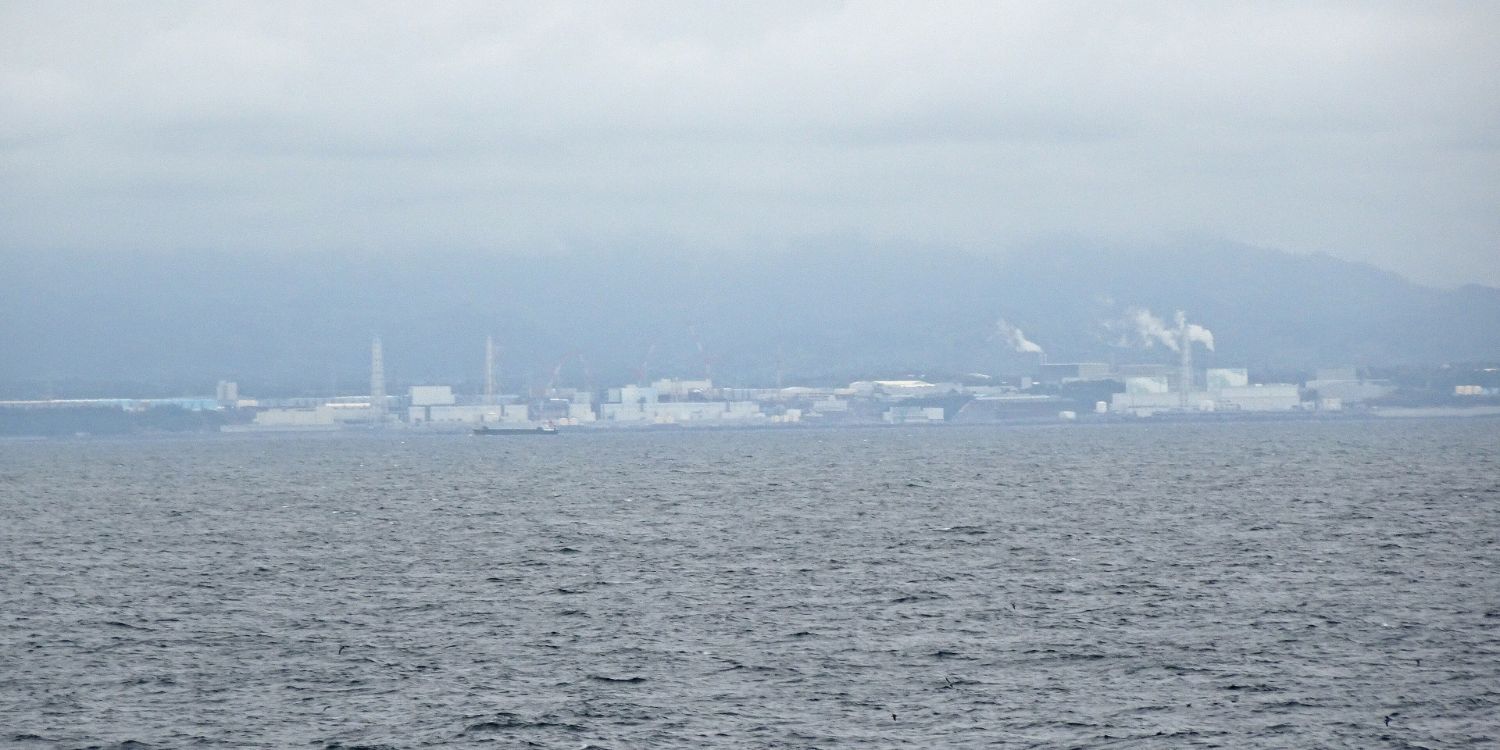
A magnitude 9.0 earthquake struck off Japan’s northeast coast on March 11, 2011, and the tsunami it triggered knocked out power and cooling at the Fukushima Daiichi nuclear plant. Fuel inside three of its six reactors melted down within days. Regulators rated it a Level 7 accident, the top of the seven-level scale built to measure nuclear accidents, the same rating Chernobyl got in 1986. TEPCO still expects full decommissioning to take 30 to 40 years from the accident, as of September 2026.
The quake, then the wave
The earthquake hit at 2:46 p.m. local time. Fukushima Daiichi’s three operating reactors, units 1 through 3, shut down automatically the instant the shaking started, exactly what a reactor is built to do. Units 4 through 6 were already offline for maintenance. The quake alone didn’t cause a meltdown.
What came next did.
The first tsunami wave reached the plant about 41 minutes later, at 3:42 p.m.. It crested at 14 to 15 meters, more than double the 6.1-meter seawall TEPCO had built by 2009. That wall was itself a jump from the plant’s original 3.1-meter design from the 1960s.
The water went over the wall, drowning 12 of the plant’s 13 backup generators along with the seawater pumps that cooled them. All six of the plant’s off-site power lines were already dead from the earthquake itself, so units 1 through 3 lost every source of power for their cooling systems at once. No grid power and no working generators is called a station blackout, the condition that turned an earthquake and a flood into a nuclear accident. It’s the failure you might have during a bad storm at home, except here the backup pumps were what stood between the reactor cores and overheating.
Why a shut-down reactor still needs cooling
A reactor that’s shut down isn’t a reactor that’s cold. The moment the control rods drop and the chain reaction stops, the fuel still holds radioactive fission byproducts such as cesium and iodine. They keep decaying on their own, and that decay throws off heat. Decay heat runs about 7% of full power at shutdown, falling to roughly 2% within the first hour and about 1% after a day, according to DOE reactor operator training material.
You don’t need reactor physics to feel why one percent still isn’t nothing, since a pot pulled off a hot burner stays too hot to touch long after the flame’s out. Unit 1 was rated at 460 megawatts of electrical output, so even a sliver of its full power is real heat with nowhere to go unless water keeps moving through the core. Cut the pumps, and the water already in the vessel boils away on its own. Once the fuel rods sit exposed to steam instead of water, the zirconium cladding around them reacts with that steam, throws off hydrogen gas, and the fuel starts to melt.
How three reactors melted down
With no power for the pumps, each of the plant’s three running reactors melted on its own timeline, as the hours below show.
| Reactor | Core damage began | What happened to the fuel |
|---|---|---|
| Unit 1 | About 4 hours after shutdown | Most fuel melted and pooled at the bottom of the pressure vessel by early March 12 |
| Unit 2 | About 77 hours after shutdown | Substantial fuel melting, containment damaged |
| Unit 3 | About 44 hours after shutdown | Fuel melted through the morning of March 13 |
Source: World Nuclear Association
Plant operators tried venting steam and pumping in seawater, improvised responses to a situation the plant wasn’t built for. It’s the kind of call you’d dread making at work with half your instruments dead, except here the stakes were three reactor cores. Neither stopped the melting, and the fuel in all three reactors slumped, in places burning through the steel of the vessels themselves.
The hydrogen building up inside the damaged reactors found an ignition source in three separate buildings. Unit 1’s reactor building exploded on the afternoon of March 12, blowing the roof and upper walls apart, and Unit 3’s building went the same way on the morning of March 14. Unit 4 had no fuel loaded in its own reactor, but it exploded anyway, after hydrogen vented from Unit 3 backed up through shared ducts and ignited early on March 15.
The blasts scattered debris and made it much harder for workers to get close enough to restore cooling.
Evacuating a quarter million people, and the deaths that followed
Japan widened its evacuation zone in stages as the accident worsened, starting with a 2-kilometer radius on the evening of March 11. By the next evening, the radius had grown to 3, then 10, then 20 kilometers.
At its peak, in May 2012, about 160,000 people had left their homes, roughly 100,000 of them still inside Fukushima Prefecture and the other 60,000 scattered elsewhere in Japan. As of May 1, 2026, the prefecture still counted 22,625 people as evacuees. If you had to leave your own town and still couldn’t move back nearly fifteen years later, that’s what the number means, since many of those evacuees come from towns where the return order has never fully lifted.
The evacuation itself had a body count. A peer-reviewed study covering March 2011 through July 2021 found 2,326 certified disaster-related deaths in Fukushima Prefecture, deaths from the physical and medical strain of the evacuation itself. The study separates these from deaths the earthquake and tsunami caused directly, and from any radiation-linked deaths. Elderly hospital and nursing-home patients were hit hardest, moved long distances under chaotic conditions with medical care interrupted.
That toll, 2,326 disaster-related deaths, was well above the 1,610 people Fukushima Prefecture lost directly to the earthquake and tsunami.
What radiation did to people’s health
The United Nations Scientific Committee on the Effects of Atomic Radiation, known as UNSCEAR, studied Fukushima’s radiation exposures for a decade, publishing its fullest assessment in 2020 and 2021. It found no adverse health effects among residents that could be attributed to radiation from the accident. It also expects future radiation-linked health effects to stay undetectable because the doses were so low.
The thyroid cancers found in screened children weren’t caused by radiation either. UNSCEAR attributes them to an unusually sensitive ultrasound program that caught thyroid abnormalities doctors wouldn’t otherwise have found at that age.
Emergency workers got a heavier dose than the public, as you’d expect from people running hoses inside a damaged plant. They averaged about 13 millisieverts between March 2011 and March 2012, and 36% of them received more than 10 millisieverts. UNSCEAR still didn’t attribute any deaths or any likely detectable rise in cancer to that exposure. That finding runs against the popular fear surrounding the disaster, worth keeping in mind whenever people debate whether nuclear power is safe.
Treated water out, fuel debris still stuck inside
Cooling the melted cores never stopped, and the water used has to go somewhere once it’s contaminated. TEPCO built the Advanced Liquid Processing System, ALPS, to filter out 62 of the water’s radioactive elements before releasing it through an offshore pipe starting August 24, 2023, keeping everything but tritium, which is chemically bound into the water and can’t be filtered out. If you’ve heard concerns about seafood near Fukushima, this is the process built to answer them, stripping out everything the filters can catch before any of it reaches the ocean.
By the end of 2025, TEPCO had discharged roughly 133,000 cubic meters across 17 batches, each diluted below regulatory tritium limits before release. The IAEA’s most recent review found the discharge meeting international safety standards in its September 2025 report.
The parts of the plant that could be defueled the normal way mostly have been. 1,331 spent fuel assemblies came out of Unit 4’s storage pool by December 2014, and Unit 3’s pool was emptied by February 2021. The harder problem is the roughly 880 tonnes of melted fuel debris fused with structural metal and concrete inside units 1 through 3, in ways nobody has fully mapped yet.
Progress there is slow on purpose. Workers pulled the first trial sample of fuel debris from Unit 2, about 0.7 grams, in November 2024, gripped by a tool built to reach through a small opening in the damaged container. TEPCO has since concluded that preparing for full-scale removal alone needs 12 to 15 years, pushing the start date to 2037 at the earliest, well past the early-2030s target officials once set.
A 2017 government estimate put the total decommissioning cost near 22 trillion yen, about $190 billion at the time, double what officials had projected a few years earlier.
What the nuclear industry changed afterward
Fukushima happened because a plant lost every source of power at once with no way to cool its cores. Regulators everywhere rewrote their rules around that failure mode. In the United States, the NRC ordered reactors to keep portable pumps and generators on hand, along with battery packs and chargers, starting in March 2012, all capable of cooling the reactor and its spent fuel pool through an event beyond the plant’s original design.
The industry built this out under the name FLEX, backed by two national response centers in Memphis and Phoenix that can ship heavier equipment to any reactor site within 24 hours. If a reactor near you shares Fukushima’s General Electric containment design, it already has the hardened vents and spent fuel pool instrumentation the NRC ordered for the 31 U.S. reactors built that way. The industry finished installing all of it at every U.S. plant, at a combined cost topping $4 billion, according to the Nuclear Energy Institute.
Spending that much money is what it costs to guard against an accident nobody predicted, not the one the plants were designed for. Not every country chose to keep paying it. Germany shut its nuclear fleet down entirely rather than retrofit it, a decision that still shapes the nuclear power outlook for the reactors still running today.