The US has 94 operating nuclear reactors at 54 power plants in 28 states, EIA counted in March 2026. A plant is a site and a reactor is one generating unit on it, so the reactor count runs higher. The fleet ran at an average capacity factor of 91% in 2025. The figures come mostly from EIA, NRC and IAEA and describe 2025 or 2026 unless a line says otherwise.
Top US nuclear power plant statistics
- EIA counted 94 operating reactors at 54 plants in 28 states as of March 2026.
- The NRC’s list of licensed power reactors had 95 units on September 14, 2026, because it includes Palisades in Michigan.
- US reactors made 785 billion kWh in 2025, about 17.7% of utility-scale generation, a share calculated from EIA data.
- The fleet peaked at 112 operable reactors in 1990 and fell to 92 in 2022.
- Illinois has the most reactors of any state, 11 as of March 2026.
- Vogtle Unit 4 in Georgia, the newest reactor, entered commercial operation on April 29, 2024.
- The World Nuclear Association’s database lists 443 operable reactors worldwide, a broader definition than IAEA’s.
- The Energy Secretary said on October 29, 2026 that the Palisades reactor in Michigan, shut since May 2022, would restart in a few weeks.
How many nuclear power plants and reactors are there in the US?
The US has 54 operating nuclear power plants with 94 reactors as of March 2026, according to EIA.
| Reactors at the plant | Plants | Reactors |
|---|---|---|
| 1 | 19 | 19 |
| 2 | 31 | 62 |
| 3 | 3 | 9 |
| 4 | 1 | 4 |
| All plants | 54 | 94 |
Source: EIA, U.S. nuclear industry, as of March 2026. The reactor column is plants multiplied by reactors per plant, and the bottom row adds it up.
For where the fleet is headed, the outlook for US nuclear power covers new builds and policy.
Which states have the most nuclear power plants?
Illinois has 11 reactors, the most of any state, according to DOE’s 2023 fast facts guide. DOE also says nuclear powers communities in 28 states, the same count EIA gives. Pennsylvania and South Carolina come next in the table above.
States with three or more operating reactors:
| State | Plants | Reactors | Net summer capacity (MW) | Plant names |
|---|---|---|---|---|
| Illinois | 6 | 11 | 11,596 | Braidwood, Byron, Clinton, Dresden, LaSalle, Quad Cities |
| Pennsylvania | 4 | 8 | 9,094 | Beaver Valley, Limerick, Peach Bottom, Susquehanna |
| South Carolina | 4 | 7 | 6,646 | Catawba, Oconee, Robinson, Summer |
| Georgia | 2 | 6 | 6,289 | Hatch, Vogtle |
| Alabama | 2 | 5 | 5,453 | Browns Ferry, Farley |
| North Carolina | 3 | 5 | 5,150 | Brunswick, Harris, McGuire |
| Florida | 2 | 4 | 3,649 | St. Lucie, Turkey Point |
| New York | 3 | 4 | 3,326 | FitzPatrick, Ginna, Nine Mile Point |
| Tennessee | 2 | 4 | 4,523 | Sequoyah, Watts Bar |
| Texas | 2 | 4 | 4,980 | Comanche Peak, South Texas Project |
| Virginia | 2 | 4 | 3,568 | North Anna, Surry |
| Arizona | 1 | 3 | 3,937 | Palo Verde |
| Michigan | 2 | 3 | 3,318 | D.C. Cook, Fermi |
| Minnesota | 2 | 3 | 1,657 | Monticello, Prairie Island |
| New Jersey | 2 | 3 | 3,459 | Hope Creek, Salem |
Source: EIA data file U.S. Nuclear Generation and Generating Capacity for June 2026. Capacity is net summer capacity in megawatts. Plants are counted by EIA plant ID and states are EIA’s. Palisades in Michigan and Crane in Pennsylvania are left out because they aren’t running.
States with one or two operating reactors:
| State | Plants | Reactors | Net summer capacity (MW) | Plant names |
|---|---|---|---|---|
| Arkansas | 1 | 2 | 1,808 | Arkansas Nuclear One |
| California | 1 | 2 | 2,240 | Diablo Canyon |
| Connecticut | 1 | 2 | 2,108 | Millstone |
| Louisiana | 2 | 2 | 2,055 | River Bend, Waterford 3 |
| Maryland | 1 | 2 | 1,745 | Calvert Cliffs |
| Ohio | 2 | 2 | 2,134 | Davis-Besse, Perry |
| Wisconsin | 1 | 2 | 1,189 | Point Beach |
| Kansas | 1 | 1 | 1,177 | Wolf Creek |
| Mississippi | 1 | 1 | 1,397 | Grand Gulf |
| Missouri | 1 | 1 | 1,190 | Callaway |
| Nebraska | 1 | 1 | 769 | Cooper |
| New Hampshire | 1 | 1 | 1,247 | Seabrook |
| Washington | 1 | 1 | 1,151 | Columbia |
Source: EIA data file U.S. Nuclear Generation and Generating Capacity for June 2026. The 28 state rows add up to 54 plants and 94 reactors with 96,855 MW of net summer capacity, a sum we calculated from EIA’s rows.
If you live in Connecticut, Dominion says its Millstone station produces nearly half of the state’s energy. If you’re in South Carolina, the company says its V.C. Summer station produces electricity for 225,000 homes. Dominion also runs two nuclear stations in Virginia, Surry and North Anna.
To find the reactors near you, look up your state in the tables above.
Why do agencies report different reactor counts?
The NRC’s list of power reactor units totals 95 units and includes Palisades, which Holtec is working to restart. EIA’s unit-level file lists 96 units, including Palisades and Crane with zero generation from January to June 2026.
NRC lists Crane, the former Three Mile Island reactor, among its sites undergoing decommissioning and leaves it off its operating list.
Agencies also place a few plants in different states. The NRC’s list puts Salem and Hope Creek in Delaware and Fermi 2 in Ohio, which is the state of the nearest city, while EIA puts them in New Jersey and Michigan. The tables here follow EIA.
A figure for plants and a figure for reactors can both be right, so check which one a page means before comparing.
How has the number of US nuclear reactors changed since 1957?
EIA’s Monthly Energy Review shows 112 operable reactors in 1990 and 94 in 2025, with 1990 the peak.
| Year-end | Operable reactors |
|---|---|
| 1960 | 3 |
| 1970 | 20 |
| 1980 | 71 |
| 1985 | 96 |
| 1990 | 112 |
| 1995 | 109 |
| 2000 | 104 |
| 2005 | 104 |
| 2010 | 104 |
| 2012 | 104 |
| 2013 | 100 |
| 2015 | 99 |
| 2018 | 98 |
| 2019 | 96 |
| 2020 | 94 |
| 2021 | 93 |
| 2022 | 92 |
| 2023 | 93 |
| 2024 | 94 |
| 2025 | 94 |
Source: EIA, Monthly Energy Review, Table 8.1 Nuclear Energy Overview, total operable nuclear generating units at year-end.
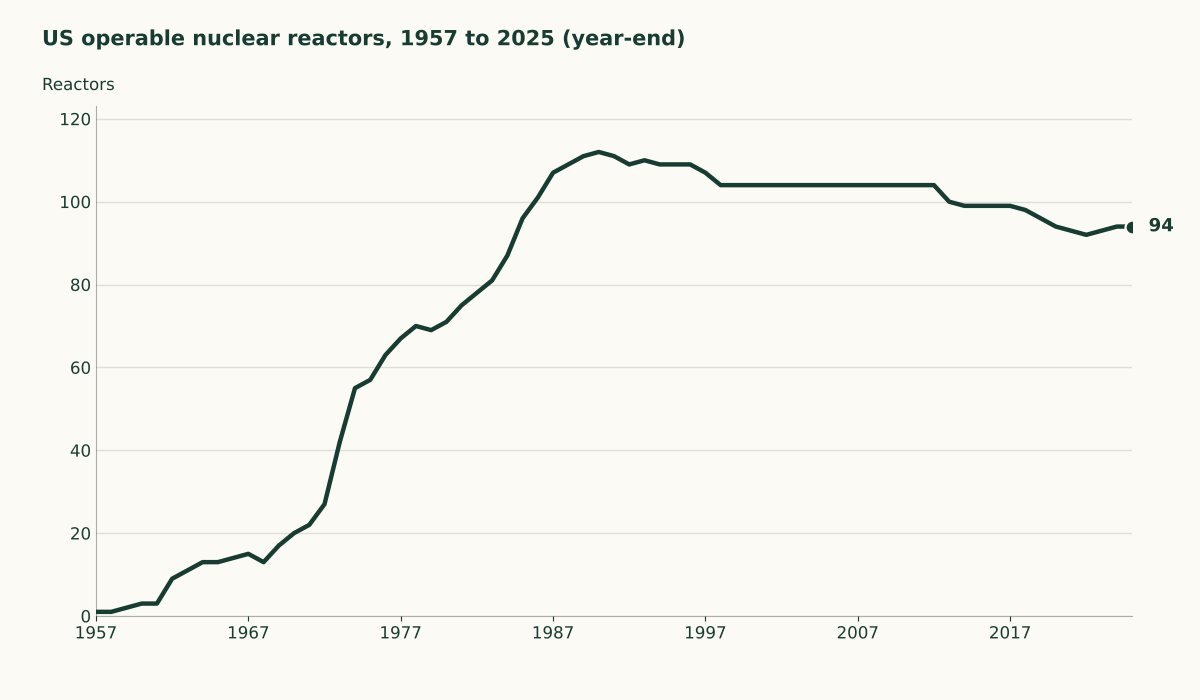
The count sat at 104 from 1998 to 2012 and then dropped to 92 by 2022 as reactors closed. The two new Vogtle reactors brought it back to 94 by 2024.
What share of US electricity comes from nuclear?
Nuclear plants made about 17.7% of US utility-scale electricity in 2025, calculated from EIA’s Electric Power Monthly.
| Year | Nuclear generation (billion kWh) | Share of US generation (%) |
|---|---|---|
| 1980 | 251.1 | 11.0 |
| 1990 | 576.9 | 19.0 |
| 2000 | 753.9 | 19.8 |
| 2010 | 807.0 | 19.6 |
| 2023 | 774.9 | 18.5 |
| 2024 | 781.9 | 18.1 |
| 2025 | 785.3 | 17.7 |
Source: EIA, Annual Energy Review 2011, Table 9.2 for 1980 to 2010, and a calculation from EIA, Electric Power Monthly, Table 1.1 for 2023 to 2025 that divides nuclear by total utility-scale generation.
The share reached 20.6% in 2001 in EIA’s historical series.
DOE says US plants produced 772 billion kWh in 2022, enough for over 72 million homes. The share of its maximum output a reactor actually delivers is its capacity factor.
Which US nuclear reactors have opened or closed since 2020?
Vogtle Unit 3 in Georgia entered commercial operation on July 31, 2023, and Unit 4 followed in April 2024. DOE says they were the first new reactors to begin construction in the US in more than 30 years.
| Date | Plant | What happened |
|---|---|---|
| April 30, 2020 | Indian Point 2, New York | Closed |
| April 30, 2021 | Indian Point 3, New York | Closed |
| May 2022 | Palisades, Michigan | Ceased operations |
| July 31, 2023 | Vogtle 3, Georgia | Commercial operation |
| April 29, 2024 | Vogtle 4, Georgia | Commercial operation |
Source: Nuclear Engineering International on Indian Point, POWER Magazine on Indian Point 2, NucNet on Indian Point 3, Nuclear Engineering International on Palisades, American Public Power Association on Vogtle and American Nuclear Society on Vogtle 4.
Indian Point 3 closed on April 30, 2021, the last of three reactors at the New York station and a year after Unit 2. If you’re a Georgia Power customer, the company says Unit 4 can power an estimated 500,000 homes and businesses. If safety is your question, the data on how safe nuclear power is compares death rates across energy sources.
How many nuclear power plants are in the world?
IAEA counted 417 operational reactors at the end of 2024, with 377 GW of capacity in 31 member states. The World Nuclear Association’s database counts a broader group it calls operable and lists 443 reactors, with 80 under construction. The two differ in definition and date.
US reactors made 781.9 TWh in 2024, 30% of the world total, the most of any country, according to IAEA.
| Year | US reactors | World reactors |
|---|---|---|
| 1995 | 108 | 434 |
| 2000 | 103 | 435 |
| 2005 | 103 | 440 |
| 2010 | 104 | 436 |
| 2015 | 99 | 416 |
| 2020 | 94 | 414 |
| 2023 | 93 | 413 |
| 2024 | 94 | 417 |
Source: IAEA, Nuclear Power Reactors in the World, 2025 edition, Table 5. Counts are operational reactors on the grid, latest in each year.
For one country that moved the other way, see what Germany’s nuclear phase-out did to emissions and coal.
How we compiled these numbers
Plant and reactor counts come from EIA’s March 2026 page and its June 2026 unit-level file, which we used to build the state tables, counting plants by EIA plant ID. We left Palisades and Crane out of every operating count, as EIA’s headline does.
The history table uses EIA’s year-end count of operable units and the world table uses IAEA’s annual report, and since they count at different dates we kept them apart. Shares for 2023 to 2025 and the capacity totals are our arithmetic, with utility-scale generation as the denominator. The page will be updated when Palisades or Crane connects to the grid, and as EIA publishes each month’s Electric Power Monthly and IAEA its annual report.
Palisades and Crane, the two idle reactors that could lift the count to 96
Palisades, an 800 MWe reactor, ceased operations in May 2022. Michigan Public noted the planned restart has been delayed before. Holtec’s estimate of reconnection by the end of February 2026 passed without a restart.
In July 2026 the company said more than 5,000 work activities remained. Holtec’s CEO, Kris Singh, told the Financial Times he expects a restart this year, ahead of a March 2027 power contract, ANS reported in July 2026.
Constellation says it still expects to restart Crane, which would add 835 MW, in 2027. The company’s CEO told investors that connecting to the PJM grid could slip into the 2030s, World Nuclear News reported in April 2026.
DOE’s loan guarantee for the Palisades restart is $1.52 billion, with $335.1 million paid out by August 2025.
Until one of them feeds power to the grid, EIA’s operating count doesn’t change, and the NRC’s reactor list shows where each one stands. If you’re comparing what a new reactor costs against other sources, solar versus nuclear cost puts the two side by side.
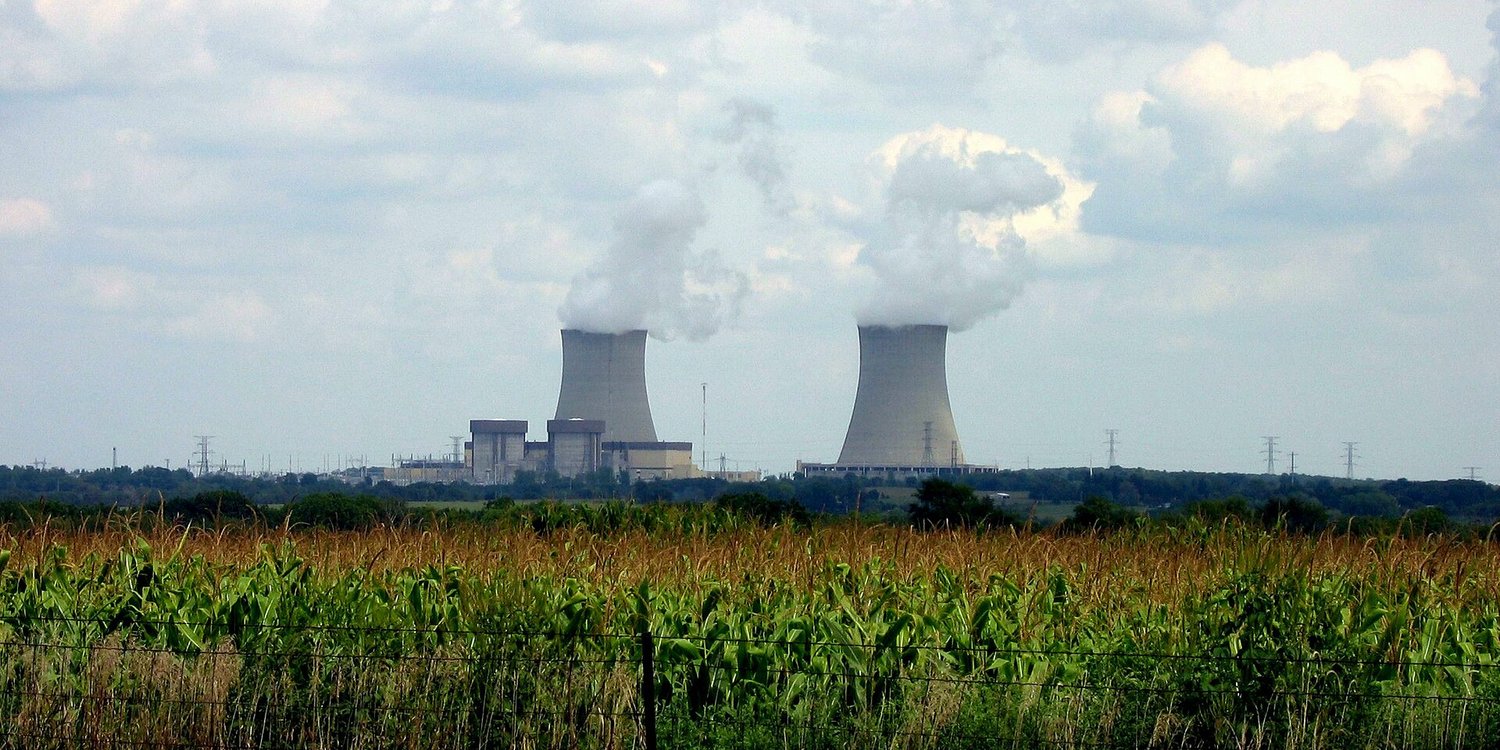
Top photo: Bill Tracey, w:Flickr user iluvcocacola, CC BY 2.0, via Wikimedia Commons, cropped.