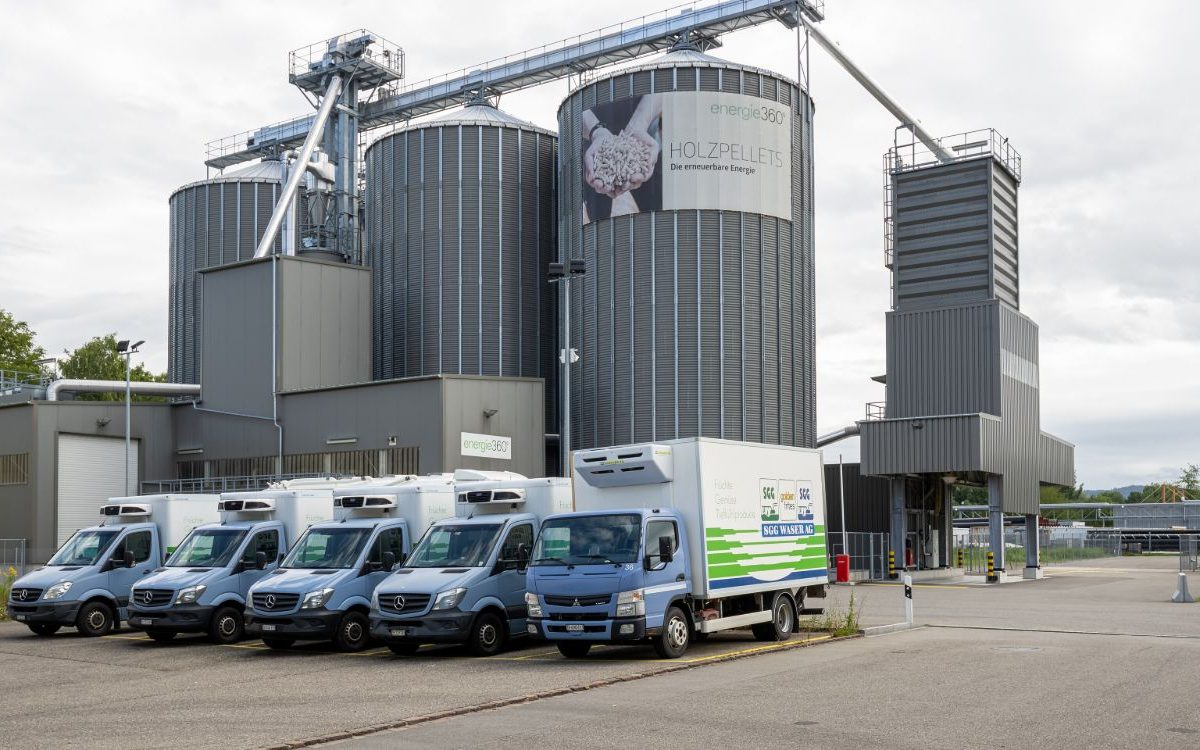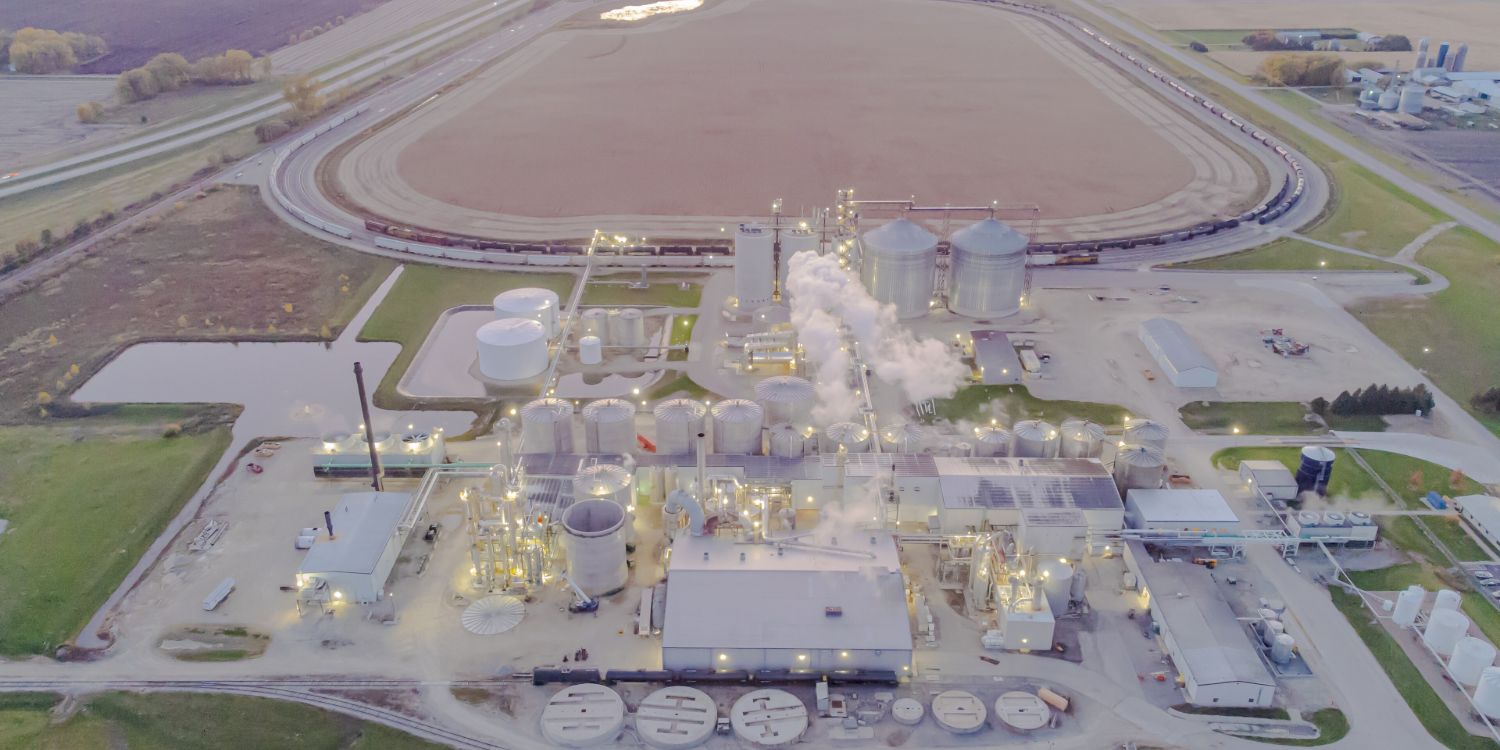
A biofuel is a liquid fuel made from plant or animal material, and the US produced 20.6 billion gallons of ethanol and biomass-based diesel in 2025, about 80% of it ethanol. If you pump gasoline, you’ve most likely burned some, since more than 98% of US gasoline contains ethanol. The figures below come mostly from EIA, USDA, EPA and the Renewable Fuels Association, and each one names the period it covers.
Top biofuel statistics
- The US produced 16,514.8 million gallons of fuel ethanol in 2025, which was 80.1% of its combined ethanol and biomass-based diesel output.
- Biomass-based diesel, meaning biodiesel plus renewable diesel, fell 15.8% in 2025 to 4,097.1 million gallons after a record 4,865.7 million in 2024.
- The Alternative Fuels Data Center lists 4,784 E85 station locations as of October 29, 2026.
- Soybean oil supplied 33.3% of the fats and oils that plants making the two diesel fuels used in 2025.
- US ethanol exports ran at 1.96 billion gallons through November 2025, on pace for a record year, the Renewable Fuels Association reports.
- The International Energy Agency expects Brazil to supply 40% of the growth in road-transport biofuel demand to 2030.
- Corn ethanol’s emissions run from about 39% below gasoline in a 2019 USDA analysis to likely at least 24% above it in a 2022 study.
- Darling Ingredients reports that its Diamond Green Diesel joint venture sold 348.8 million gallons of renewable fuels in the second quarter of 2026.
What is a biofuel, and is it renewable?
Biofuels are, in EIA’s wording, liquid fuels and blending components made from biomass, the organic material that comes from plants and animals. In the US that mostly means ethanol, which is made from corn starch in 94% of cases, plus biodiesel and renewable diesel made from fats and oils.
Is a biofuel renewable? EIA calls biomass renewable organic material, and it supplied about 5% of US primary energy in 2025. Biofuels were 53% of the biomass energy the US used that year, the largest slice of the wider biomass energy picture.
Whether a crop-based fuel counts as renewable in practice depends on regrowth keeping pace with harvest, which the page on biomass as a renewable resource works through. Renewable and low-carbon are separate questions, and the lifecycle estimates for corn ethanol further down span a wide range.
How much biofuel does the US make?
US ethanol production rose from 13,929.1 million gallons in 2011 to 16,514.8 million in 2025. Over the same years, renewable diesel grew from 62.0 million gallons to 2,946.2 million.
| Year | Ethanol (million gallons) | Biodiesel (million gallons) | Renewable diesel (million gallons) |
|---|---|---|---|
| 2011 | 13,929.1 | 967.5 | 62.0 |
| 2012 | 13,218.0 | 990.7 | 52.4 |
| 2013 | 13,292.7 | 1,359.5 | 113.3 |
| 2014 | 14,312.8 | 1,279.0 | 159.1 |
| 2015 | 14,807.2 | 1,263.3 | 176.8 |
| 2016 | 15,413.2 | 1,567.7 | 241.5 |
| 2017 | 15,936.3 | 1,595.7 | 258.3 |
| 2018 | 16,091.3 | 1,857.3 | 305.5 |
| 2019 | 15,778.5 | 1,724.5 | 492.0 |
| 2020 | 13,941.0 | 1,814.7 | 533.5 |
| 2021 | 15,015.7 | 1,708.8 | 861.1 |
| 2022 | 15,360.7 | 1,622.0 | 1,499.1 |
| 2023 | 15,580.2 | 1,696.8 | 2,599.6 |
| 2024 | 16,225.3 | 1,671.4 | 3,194.3 |
| 2025 | 16,514.8 | 1,150.9 | 2,946.2 |
Source: EIA Monthly Energy Review Table 10.3, Table 10.4a and Table 10.4b, September 2026 edition, calendar years. The 2025 figures are preliminary.
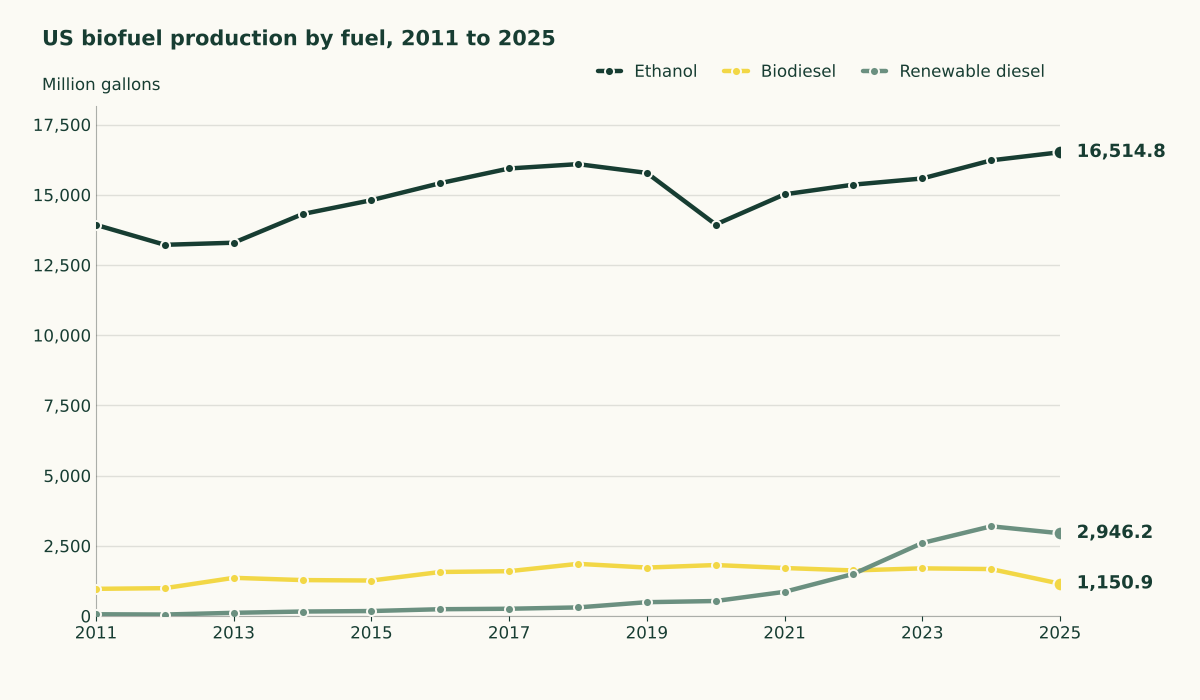
Renewable diesel did the climbing, and the last row of the table shows both diesel fuels falling. Biodiesel dropped 31.1% to 1,150.9 million gallons. Renewable diesel’s fall was smaller, 7.8% to 2,946.2 million.
Through the first six months of 2026, plants made 8,314.6 million gallons of ethanol and 2,286.2 million gallons of biodiesel and renewable diesel combined. Those are half-year totals, so they don’t compare with the full years in the table. On the company side, Darling Ingredients reports that its Diamond Green Diesel joint venture sold 348.8 million gallons of renewable fuels in the second quarter of 2026.
EIA’s October 2026 outlook forecasts ethanol at 1.10 million barrels a day in 2026, up from 1.08 million in 2025. It has renewable diesel at 0.23 million barrels per day in 2026, up from 0.19 million.
The combined total, the ethanol share and the fall in biomass-based diesel are computed from EIA’s three fuel tables, so they cover those fuels and leave out EIA’s separate category for other biofuels. EIA revises annual figures as new months arrive, so the 2025 numbers can move.
How each fuel gets made
Ethanol is grain alcohol. Producers use yeast to ferment the starch or sugar in corn or sugarcane, distill the result up to fuel grade and add a denaturant so it can’t be sold as a beverage, as EIA explains. It’s the same basic biology as a distillery, aimed at your gas tank instead of a bottle.
Biodiesel takes a different chemical path, called transesterification. A producer mixes roughly 100 pounds of oil with 10 pounds of methanol and a catalyst such as sodium or potassium hydroxide. The reaction yields 100 pounds of biodiesel and 10 pounds of glycerin, according to the Department of Energy’s Alternative Fuels Data Center.
That glycerin isn’t waste. It’s sold into pharmaceutical and cosmetics manufacturing.
Renewable diesel skips transesterification. Refiners run the same fats and oils through hydrotreating, adding hydrogen under heat and pressure to strip out oxygen and produce what the industry calls hydroprocessed esters and fatty acids, or HEFA. The output is a hydrocarbon chain almost indistinguishable from petroleum diesel, so it meets ASTM D975, the petroleum diesel spec, instead of the separate ASTM D6751 standard written for biodiesel.
What feeds the vats and reactors
Corn is the main US ethanol feedstock, and ethanol and its by-products took 5,547 million bushels of it in the 2025/26 marketing year, about 33.7% of all US corn use by a share computed from USDA’s table. The figure includes by-products, so it overstates the corn that becomes fuel itself. USDA’s Economic Research Service projected in July 2026 that 5.55 billion bushels would be the second-largest amount on record.
The two diesel fuels draw on a wider menu of fats and oils. Soybean oil supplied 11,016 million pounds in 2025, or 33.3% of the total, down from 13,320 million pounds in 2024.
| Feedstock | 2024 (million lb) | 2025 (million lb) | 2025 share (%) |
|---|---|---|---|
| Soybean oil | 13,320 | 11,016 | 33.3 |
| Tallow | 7,271 | 9,025 | 27.3 |
| Yellow grease | 7,387 | 5,166 | 15.6 |
| Corn oil | 4,335 | 4,568 | 13.8 |
| Canola oil | 4,835 | 2,625 | 7.9 |
| White grease | 694 | 516 | 1.6 |
| All other | 495 | 125 | 0.4 |
| Total | 38,337 | 33,041 | 100.0 |
Source: EIA, Feedstocks Consumed for Production of Biofuels, release of September 30, 2026, calendar years. Shares are computed from EIA’s totals.
Tallow passed yellow grease in 2025, with 9,025 million pounds against 5,166 million. EIA’s table reports yellow grease and has no separate used cooking oil line.
USDA counts soybean oil on a different calendar. Its October 2026 WASDE has 14,800 million pounds going to biofuel in the 2025/26 marketing year, about 49% of domestic soybean oil use, on a year that runs October to September. USDA also expects the oil to average 64.08 cents a pound over the marketing year ending in September 2026, against 47.59 cents the year before.
Which countries make the most biofuel?
The US made 16,494 million gallons of fuel ethanol in 2025, 52% of a world total of 32,000 million, by the Renewable Fuels Association’s count.
| Country or region | 2021 (million gallons) | 2024 (million gallons) | 2025 (million gallons) | 2025 share (%) |
|---|---|---|---|---|
| United States | 15,016 | 16,225 | 16,494 | 52 |
| Brazil | 7,240 | 8,980 | 8,650 | 27 |
| India | 830 | 1,840 | 2,600 | 8 |
| European Union | 1,380 | 1,480 | 1,500 | 5 |
| China | 900 | 1,170 | 1,030 | 3 |
| Canada | 434 | 464 | 472 | 1 |
| Thailand | 350 | 360 | 390 | 1 |
| Argentina | 270 | 310 | 330 | 1 |
| Rest of world | 470 | 531 | 534 | 2 |
| World total | 26,890 | 31,360 | 32,000 | 100 |
Source: Renewable Fuels Association, Annual World Fuel Ethanol Production. RFA’s US figure differs from EIA’s.
Brazil, whose ethanol comes mostly from sugar cane, made less in 2025 than in 2024, while India’s output rose 41% to 2,600 million gallons. The IEA expects the US to remain the largest biofuel producer and consumer through 2030.
The two US counts differ slightly. EIA has 16,514.8 million gallons for 2025, which is 21 million more than RFA’s count. Neither source says why.
Gallons made and gallons burned at home differ too. US consumption was 14,340.7 million gallons in 2025, about 2,174 million below production. RFA reports exports on pace to pass 2 billion gallons that year.
How much of each you can put in a tank
Ethanol made 10.5% of US gasoline in 2025, and EIA’s June 2026 outlook expects 10.7% in 2026. The blend wall is the point at which fuel infrastructure and all vehicle engines would need updating to take more than E10.
| Blend | Fuel | Biofuel share | Who can use it |
|---|---|---|---|
| E10 | Ethanol | Up to 10% | Any gasoline vehicle |
| E15 | Ethanol | Up to 15% | Light-duty vehicles from model year 2001 on |
| E85 | Ethanol | 51% to 83% | Flex-fuel vehicles only |
| B5 | Biodiesel | Up to 5% | Current diesel engines without changes |
| B20 | Biodiesel | 6% to 20% | Many diesel engine makers approve it |
| B100 | Biodiesel | 100% | Rarely used as a transportation fuel |
| R100 | Renewable diesel | 100% | Diesel engines as a full replacement |
Source: EIA, Ethanol and the blend wall, AFDC, Biodiesel blends and AFDC, Renewable diesel.
E15 is approved for model year 2001 and newer light-duty vehicles, so if your car is that age or newer, you can likely use it. E85 goes further, at 51% to 83% ethanol, but it needs a flex-fuel vehicle. AFDC lists 4,784 E85 station locations, 1,997 for biodiesel and 1,237 for renewable diesel as of October 29, 2026.
EPA issued the first nationwide fuel waiver for the 2026 summer on March 25, 2026, which let E15 be sold from June 1 to September 15. The House passed year-round E15 legislation on May 13, 2026, by 218 votes. The bill went to the Senate.
The most common biodiesel blends are B5 and B20, and many diesel engine makers approve B20, so check your warranty before you fill a diesel pickup with it. At the other end, renewable diesel faces no such ceiling, because AFDC says it can fully replace petroleum diesel or be blended in any amount.
The federal program that created this market
EPA finalized the 2026 and 2027 Renewable Fuel Standard volumes on March 27, 2026, setting total renewable fuel at 26.81 billion Renewable Identification Numbers (RINs) for 2026 and 27.02 billion for 2027. Refiners and importers are the program’s obligated parties. They must retire enough RINs to meet an annual quota, and one RIN stands for one ethanol-equivalent gallon.
| RFS category | 2026 total (billion RINs) | 2026 reallocated (billion RINs) | 2027 total (billion RINs) | 2027 reallocated (billion RINs) |
|---|---|---|---|---|
| Cellulosic biofuel | 1.36 | 0 | 1.43 | 0 |
| Biomass-based diesel | 9.07 | 0.21 | 9.20 | 0.25 |
| Advanced biofuel | 11.10 | 0.28 | 11.32 | 0.34 |
| Total renewable fuel | 26.81 | 0.99 | 27.02 | 1.04 |
Source: EPA, Final Renewable Fuel Standards for 2026 and 2027. Reallocated volume is EPA’s 70 percent reallocation of small refinery exemptions granted for 2023 through 2025.
EPA set 2026 biomass-based diesel at 9.07 billion RINs and cellulosic biofuel at 1.36 billion, after partially waiving the 2025 cellulosic requirement for a production shortfall.
RINs aren’t gallons. A gallon of biodiesel generates 1.5 RINs and a gallon of ethanol generates 1.0. As of June 4, 2026, D4 RINs traded at $2.41 and D6 RINs at $2.37, both close to their all-time highs set in 2021.
California’s carbon math, and the credit that replaced it
California runs its own carbon pricing system on top of the federal one. Its Low Carbon Fuel Standard, or LCFS, tallies credits and deficits by the carbon intensity of each transportation fuel.
In the first quarter of 2026, CARB counted 6.93 million metric tons of credits against 9.77 million metric tons of deficits. The cumulative bank stood at 36.86 million metric tons, and regulated entities can still correct the quarterly figures.
A newer federal tax credit reshaped the incentive further. The Clean Fuel Production Credit, known as 45Z, replaced older, separate blender credits for biodiesel and sustainable aviation fuel with one production credit for fuel made starting January 1, 2025, according to the American Farm Bureau Federation. It pays 20 cents a gallon at the base rate, and the law limits qualifying feedstock to North America.
The 2025 reconciliation law, the One Big Beautiful Bill Act, extended 45Z through 2029 and dropped indirect land-use-change emissions (ILUC) from the carbon scores, which lowers scores for corn ethanol and soy biodiesel by up to 20 to 25 grams of CO2-equivalent per megajoule, per the Clean Air Task Force.
Treasury proposed 45Z regulations on February 4, 2026, and IRS Notice 2026-53 on September 8, 2026 set the 2026 emissions rate table. The Joint Committee on Taxation estimates the credit will cost $25.7 billion through 2029, the Clean Air Task Force reports, against an original estimate near $2.9 billion.
Sustainable aviation fuel is next
Sustainable aviation fuel, or SAF, is jet fuel that can be made through HEFA, the same hydrotreating process renewable diesel uses. EIA estimated US capacity at about 30,000 barrels a day in May 2025, counting only HEFA SAF.
Even at that pace, EIA expected SAF to stay under 2% of the 1.7 million barrels a day of US jet fuel in 2025 and near 2% in 2026. Your seat on a US flight is still burning almost entirely petroleum jet fuel.
Capacity built unevenly. Phillips 66 finished its 10,000-barrel-a-day Rodeo project in California in the third quarter of 2024 and then temporarily halted production in the fourth, while Diamond Green Diesel completed a 15,000-barrel-a-day unit at Port Arthur, Texas, in the fourth quarter of 2024.
The 2025 law cut the SAF credit from $1.75 a gallon to the same $1 cap that applies to other biofuels. EIA’s October 2026 outlook puts other biofuels, the category that holds SAF, at 0.04 million barrels per day in both 2025 and 2026.
Is biofuel better for the climate than gasoline?
Estimates of corn ethanol’s emissions against gasoline run from clearly better to likely worse, depending on what each study counts.
| Source | Year | Method | Corn ethanol vs gasoline |
|---|---|---|---|
| RFS statutory minimum for conventional biofuel | 2007 law | Required cut vs 2005 petroleum baseline | At least 20% lower |
| USDA life-cycle analysis | 2019 | Model-based life-cycle analysis | About 39% lower |
| Argonne GREET | 2021 | Model-based life-cycle analysis including land-use change | More than 40% lower |
| Lark and colleagues in PNAS | 2022 | Observed US cropland change after the RFS | No less than gasoline and likely at least 24% higher |
Source: EPA, Overview of the Renewable Fuel Standard. USDA, corn ethanol greenhouse gas analysis. Argonne National Laboratory, GREET model results. Lark and colleagues, PNAS.
The USDA and Argonne rows model the average life cycle of a gallon of ethanol, and Argonne presented its figure at an industry conference. The PNAS paper estimates what the policy changed on the ground instead. It found the RFS raised corn prices by 30% and added 2.1 million hectares of cropland between 2008 and 2016, and the Great Lakes Bioenergy Research Center summarizes its conclusion that corn ethanol failed to meet the policy’s own greenhouse gas emissions targets.
EPA’s third triennial report to Congress found that the RFS had a modest positive effect on biofuel production and so a modest negative effect on the environment. Both diesel fuels face a tougher test than corn ethanol, because the RFS requires a 50% lifecycle cut from them.
Your grocery bill and your gas tank pull from the same soybean field
Soybean oil goes into both tanks and kitchens, and USDA’s October 2026 WASDE puts the biofuel share of domestic use near half. The American Soybean Association put the 2024 record for US biomass-based diesel production at 4.86 billion gallons. It calculates actual 2026 use at 5.86 billion gallons once backfill and exemptions are counted, with 5.66 billion gallons from US plants.
The 5.86 billion is use, not production, and the analysis predates EPA’s final rule.
Whether farmland pushed into fuel crops adds carbon is the same accounting debate that surrounds whether biomass is carbon neutral. The clean fuel credit described above leaves indirect land-use change out of its scoring.
At the grocery store, USDA’s Economic Research Service forecasts food-at-home prices up 2.3% in 2026 in its October 23, 2026 update, with prices for fats and oils below 2025’s. At the pump, the blend table above lists which vehicles can take each fuel, and your owner’s manual settles the rest.