Yes, biomass counts as renewable energy as long as it’s harvested no faster than plants regrow, and US timberland met that test nationally in 2016 with 25 billion cubic feet of net growth against 13 billion removed. Biomass supplied 54.9% of US renewable energy consumption in 2025, and governments don’t all apply the same test to it.
Top biomass renewable statistics
- EIA puts biomass at about 5% of all US energy consumed in 2025.
- In the Rocky Mountain region, high tree mortality left a growth-to-removals ratio of 0.74 in the Forest Service’s 2017 report.
- Modern bioenergy supplied 45% of the world’s renewable energy supply in 2024.
- Bioenergy plants made up 3.0% of the world’s installed renewable power capacity in 2025, a share computed from IRENA’s totals.
- Ember counts biomass at 2.24% of world electricity and 1.02% of US electricity in 2025.
- FAO reports deforestation of 10.9 million hectares a year in 2015 to 2025, down from 17.6 million a year in 1990 to 2000.
- Managed loblolly pine stands in the US South can reach sawtimber size in 25 to 40 years.
Is biomass renewable?
Biomass is renewable when new growth replaces what’s burned, which matches the IPCC’s definition of renewable energy as energy replenished by natural processes at least as fast as it’s used.
EIA describes biomass as renewable organic material that comes from plants and animals. The IPCC’s AR6 energy chapter lists bioenergy among renewable energy with wind, solar, hydroelectric, geothermal, tidal and ocean power, the other types of renewable energy.
Ember counts bioenergy as renewable because forest and energy crops can be regrown and replenished, which isn’t true of burning fossil fuels. The plant and animal materials that count as biomass are covered in how biomass energy is used.
Is renewable the same as carbon neutral?
No. The IPCC defines carbon neutrality as a condition in which anthropogenic CO2 emissions are balanced by anthropogenic CO2 removals, which is a different test from whether a fuel replenishes.
EIA calls biomass a carbon-neutral energy source because its source plants take in nearly as much CO2 as burning releases. IPCC inventory rules report CO2 from biomass fuels in the land-use sector and leave it out of energy totals, and Ember adds that the lifecycle carbon intensity the IPCC reports for bioenergy is higher than for other renewables.
Whether regrowth offsets the carbon released by burning is the subject of our page on whether biomass counts as carbon neutral.
Who counts biomass as renewable?
EIA, the IPCC’s energy chapter, US law, North Carolina, the EU and Ember all count biomass as renewable, and the legal definitions add conditions about land, forests and lifecycle emissions.
| Body | Counts biomass as renewable | Main condition |
|---|---|---|
| EIA (US) | Yes | Replenishing organic material |
| IPCC AR6 | Yes | Replenished at or above rate of use |
| US Renewable Fuel Standard | Yes, if renewable biomass | Land-date limits and 20, 50 or 60% lifecycle GHG cuts |
| US federal purchasing law | Yes | Electric energy from biomass |
| North Carolina | Yes | Listed biomass types |
| EU Renewable Energy Directive | Yes, if sustainable | No-go land and GHG criteria for plants of 7.5 MW and up |
| Ember | Yes | Notes higher lifecycle carbon |
Source: EIA, Renewable energy explained, IPCC AR6 WG3 glossary, IPCC AR6 WG3 chapter 6, EPA, Renewable Fuel Standard overview, 40 CFR 80.2, 42 USC 15852, North Carolina G.S. 62-133.8, European Commission, Biomass and Ember, Global Electricity Review 2026.
The US Renewable Fuel Standard counts planted crops and crop residue only from agricultural land cleared or cultivated before December 19, 2007, and planted trees only from non-federal tree plantations. It also requires lifecycle greenhouse gas cuts of 60% for cellulosic biofuel and 50% for advanced biofuel. Corn starch ethanol needs a cut of 20%.
Electricity works differently. EIA says no federal renewable portfolio standard exists, though a federal Renewable Fuel Standard oversees transportation fuels such as ethanol and other biofuels. Federal law on government electricity purchases defines renewable energy to include electric energy produced from biomass.
Your state may decide which biomass counts. EIA says many states specify the types of renewable energy and technologies that qualify, and North Carolina’s statute lists wood waste and energy crops as renewable energy resources.
The EU’s directive puts primary and old-growth forests, peatland and other no-go areas off limits for biomass that counts toward its renewable targets or receives subsidies.
How long does biomass take to regrow?
Energy grasses like miscanthus are harvested every year, and northern hardwood stands run on rotations of 50 to 120 years or more.
| Feedstock | Shortest cycle (years) | Longest cycle (years) |
|---|---|---|
| Corn stover (annual crop residue) | 1 | 1 |
| Miscanthus (energy grass) | 1 | 1 |
| Short rotation coppice (willow, poplar) | 2 | 5 |
| Managed loblolly pine (sawtimber) | 25 | 40 |
| Northern hardwoods (even-aged) | 50 | 120 or more |
Source: Sanford et al., Agriculture, Ecosystems & Environment, 2016, Forest Research (UK), Energy crops: Grasses, University of Arkansas Extension, loblolly pine and Minnesota DNR, northern hardwoods guidelines. The coppice figure is a UK harvest cycle and the pine and hardwood figures are US rotations.
Corn stover is the residue of an annual crop, while an unmanaged loblolly pine stand can take up to 50 years to reach sawtimber size, against 25 to 40 years under management.
Are US forests growing faster than they’re harvested?
The balance varies by region. In the North, net growth was 2.4 times removals, against 1.8 times in the South, while in the Rocky Mountains removals outran growth.
| Region | Net growth to removals (ratio) |
|---|---|
| North | 2.4 |
| South | 1.8 |
| Pacific Coast | 2.0 |
| Rocky Mountains | 0.74 |
| United States | 1.9 |
Source: USDA Forest Service Indicator 2.13 and Forest Resources of the United States 2017. Ratios describe inventories through 2016, and removals cover all harvest, whatever the wood is used for. The Pacific Coast value is the Forest Service’s “twice,” and the national ratio is computed from 25 and 13 billion cubic feet.
If the wood for a plant near you comes from the North or the South, the Forest Service count says growth in those regions outran removals from all uses, which tests the region and says nothing about that one plant.
In the Rocky Mountains the low ratio traces to tree mortality. Softwood mortality there doubled since 2006, from 1.2 to 2.4 billion cubic feet a year, and the Forest Service says removals in the region are among the lowest in the country.
How much of US renewable energy is biomass?
Biomass supplied 54.9% of US renewable energy in 2025, down from 81.9% in 1950, and the yearly table shows the share falling since 2010 as all renewables together grew faster than biomass.
| Year | Biomass (quads) | All renewables (quads) | Biomass share of renewables (%) | Biomass share of all US energy (%) |
|---|---|---|---|---|
| 2001 | 2.622 | 3.512 | 74.7 | 2.8 |
| 2002 | 2.701 | 3.766 | 71.7 | 2.8 |
| 2003 | 2.806 | 3.916 | 71.7 | 2.9 |
| 2004 | 3.008 | 4.106 | 73.3 | 3.1 |
| 2005 | 3.114 | 4.233 | 73.6 | 3.2 |
| 2006 | 3.262 | 4.480 | 72.8 | 3.4 |
| 2007 | 3.485 | 4.595 | 75.8 | 3.5 |
| 2008 | 3.851 | 5.068 | 76.0 | 4.0 |
| 2009 | 3.940 | 5.293 | 74.4 | 4.3 |
| 2010 | 4.506 | 5.896 | 76.4 | 4.7 |
| 2011 | 4.616 | 6.308 | 73.2 | 4.9 |
| 2012 | 4.517 | 6.151 | 73.4 | 4.9 |
| 2013 | 4.861 | 6.587 | 73.8 | 5.2 |
| 2014 | 5.013 | 6.796 | 73.8 | 5.3 |
| 2015 | 5.008 | 6.823 | 73.4 | 5.3 |
| 2016 | 5.053 | 7.112 | 71.1 | 5.4 |
| 2017 | 5.035 | 7.377 | 68.3 | 5.4 |
| 2018 | 5.096 | 7.530 | 67.7 | 5.2 |
| 2019 | 5.048 | 7.591 | 66.5 | 5.2 |
| 2020 | 4.535 | 7.296 | 62.2 | 5.1 |
| 2021 | 4.753 | 7.656 | 62.1 | 5.1 |
| 2022 | 4.980 | 8.233 | 60.5 | 5.2 |
| 2023 | 5.021 | 8.320 | 60.3 | 5.4 |
| 2024 | 5.101 | 8.726 | 58.5 | 5.4 |
| 2025 | 4.853 | 8.835 | 54.9 | 5.0 |
Source: EIA, Monthly Energy Review Table 1.3, annual values in quadrillion Btu. Shares are computed from EIA’s unrounded values, and 2025 is preliminary.
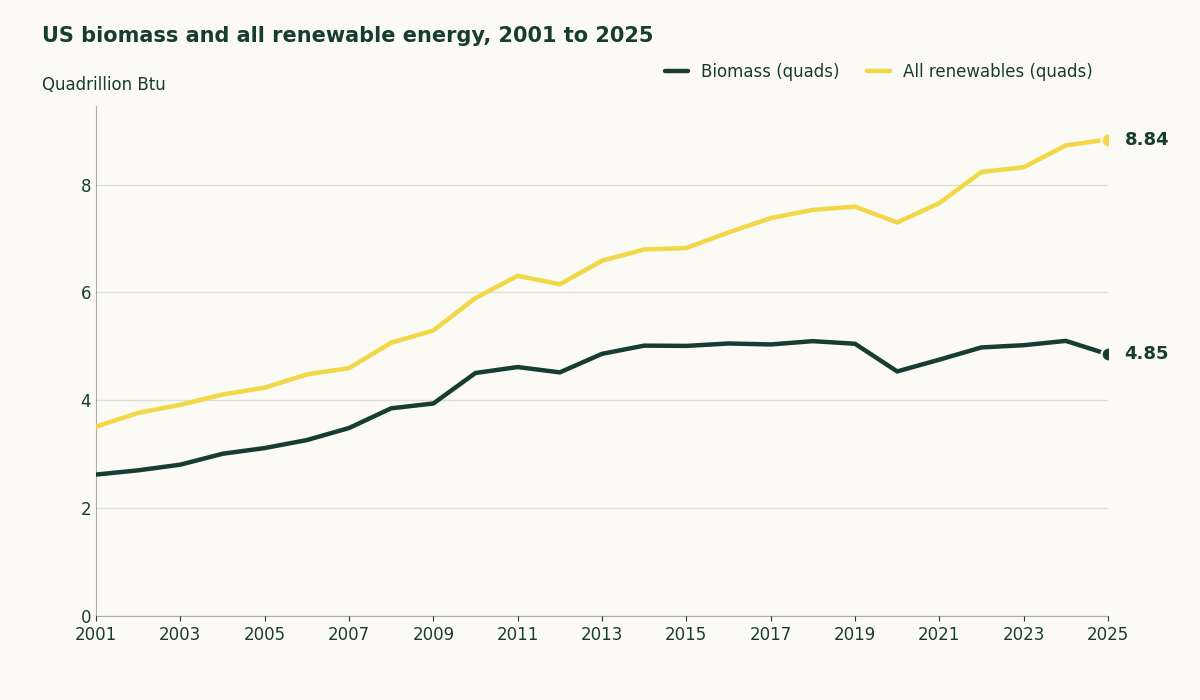
Biomass use peaked at 5.101 quads in 2024 and fell to 4.853 in 2025, on EIA’s preliminary count, while all renewables kept growing.
How much renewable energy is biomass worldwide?
Modern bioenergy supplied 45% of the world’s renewable energy supply in 2024. At your wall outlet it is a sliver, 1.02% of US electricity in 2025. The gap comes from what each yardstick counts, and from where.
| Yardstick | Scope | Period | Biomass share (%) |
|---|---|---|---|
| EIA renewable energy consumption | US | 2025 | 54.9 |
| IEA renewable energy supply, modern bioenergy | World | 2024 | 45 |
| IEA renewable energy supply, modern plus traditional | World | 2024 | 64 |
| EU renewable energy consumption | EU | 2021 | 59 |
| IRENA renewable capacity | World | 2025 | 3.0 |
| IRENA renewable capacity | US | 2025 | 2.2 |
| Ember electricity generation | World | 2025 | 2.24 |
| Ember electricity generation | US | 2025 | 1.02 |
Source: EIA, Monthly Energy Review Table 1.3, IEA Bioenergy, Role of Bioenergy up to 2050, European Commission, Biomass, IRENA, Renewable Energy Statistics 2026 and Ember via Our World in Data. The IEA total of 64% adds its 45% and 19% shares, the EIA and IRENA shares are computed, and the EU figure is for 2021.
Capacity counts power plant size in megawatts, so it can’t be compared with energy supply in quads or electricity in kilowatt-hours. IRENA counts US bioenergy capacity falling from 12,903 MW in 2016 to 10,314 MW in 2025, so only compare rows that share a yardstick.
When does biomass stop being renewable?
Biomass stops being renewable when harvest outruns regrowth, and a 2015 study in Nature Climate Change estimated that 27% to 34% of the pan-tropics’ 2009 woodfuel harvest was unsustainable. The study notes that over half of all wood harvested worldwide is used as fuel, supplying about 9% of global primary energy.
FAO’s 2025 assessment puts net forest loss at 4.12 million hectares a year in 2015 to 2025, down from 10.7 million hectares a year in the 1990s. That is a net figure for all forest change, and it doesn’t single out wood burned for energy.
Crop residue has its own limit. USDA scientists say stover harvest has to avoid worsening soil erosion or degrading soil organic carbon, and at the roughly one third of study sites where they could estimate it, the minimum residue return rate was 3.9 megagrams of stover per hectare a year.
The IPCC’s AR6 energy chapter says growing dedicated bioenergy crops raises a broad set of sustainability concerns, which leaves the long-term role of bioenergy in low-carbon energy systems uncertain.
What wood does Drax source?
Drax Group sourced 9.74 million tonnes of wood fibre in 2025, and sawmill and other wood industry residues were 53.4% of it.
| Fibre type | Tonnes (2025) | Share of total (%) |
|---|---|---|
| Sawmill and other wood industry residues | 5,201,941 | 53.4 |
| Low-grade roundwood | 2,828,298 | 29.0 |
| Thinnings | 1,127,530 | 11.6 |
| Branches and tops | 344,691 | 3.5 |
| Non-woody biomass | 210,409 | 2.2 |
| Salvage trees | 25,543 | 0.3 |
Source: Drax Group, ESG Performance Report 2025, group-wide fibre sourced. Shares are computed from those tonnes.
Thinnings and low-grade roundwood together were 40.6% of the fibre, a share computed from the same table.
In February 2025 the UK government agreed to cut Drax’s subsidies by 50% from 2027 to 2031, Power Technology reported, citing Reuters. Drax also committed to source all of its woody biomass from “sustainable origins.”
Where these numbers come from
Each share in the US history, yardstick and Drax tables is one sourced total divided by another, and the table’s source line says so. The 2025 US figures are EIA’s preliminary count, and the other figures cover different years, so read each against the year beside it.
What to ask before you accept that biomass is renewable
The European Commission is preparing its post-2030 renewable energy framework, with proposals scheduled by the end of 2026.
When someone tells you a biomass project is renewable, ask what the fuel is and which rule counts it. With those two answers you can tell whether the claim rests on a residue or on standing trees, and which clock in the regrowth table above applies.