A nuclear reactor splits uranium atoms, the heat boils water, and the steam spins a turbine, which at Georgia’s Vogtle Unit 4 turns 3,400 megawatts of heat into 1,117 megawatts of electricity. The same steps run all 94 US reactors, and the plant ends up making electricity like a coal plant does, with fission replacing the burning. The figures come mostly from DOE, NRC, EIA and the World Nuclear Association, and each says the period it describes.
Top nuclear energy statistics
- One fission of a U-235 atom releases about 200 MeV of energy, according to the World Nuclear Association.
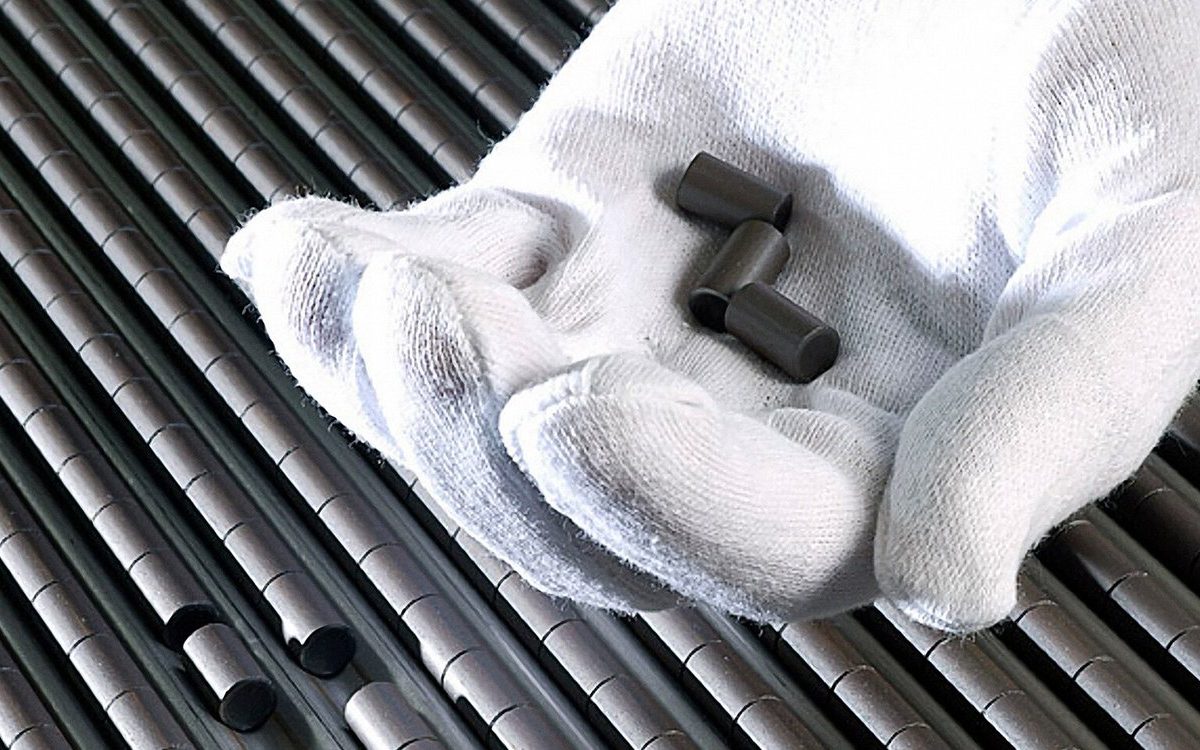
- EIA says the energy in one uranium pellet matches 150 gallons of oil.
- Natural uranium is 0.711% U-235, and commercial reactor fuel is enriched to 3% to 5%.
- In March 2026 EIA counted 94 reactors at 54 power plants spread over 28 states.
- NRC’s list of power reactors, reviewed on September 14, 2026, shows 64 pressurized water reactors and 31 boiling water reactors.
- The US nuclear fleet’s average heat rate was 10,443 Btu per kilowatt-hour in 2025, which works out to an efficiency of 32.7%.
- US plants typically refuel every 18 to 24 months, according to EIA’s 2018 count.
How does a nuclear reactor turn uranium into electricity?
A reactor makes electricity in nine steps, and a single Vogtle unit shows the number at each one.
| Step | What happens | Number at this step |
|---|---|---|
| 1. Enrichment | Natural uranium is enriched in U-235 | 0.711% to 3% to 5% U-235 |
| 2. Pellet | Enriched uranium is pressed into a ceramic pellet | about 1 cm wide, 1.5 cm long |
| 3. Fuel rods | Pellets stack in sealed metal rods bundled into assemblies | 200+ rods per assembly |
| 4. Fission | Neutrons split U-235 nuclei and release heat | about 200 MeV per fission |
| 5. Core heat | The chain reaction heats the water around the fuel | 3,400 MW of heat (Vogtle 4) |
| 6. Steam | A PWR boils a second water loop and a BWR boils the core water | 2 loops (PWR) or 1 loop (BWR) |
| 7. Turbine and generator | Steam spins the turbine that drives the generator | 1,117 MW of electricity (Vogtle 4) |
| 8. Condenser | Leftover steam turns back into water | about 2 units of heat per 1 of electricity |
| 9. Refueling | The reactor stops and part of the fuel is swapped | every 18 to 24 months |
Source: World Nuclear Association, Vogtle 4 reactor database, World Nuclear Association, Physics of Nuclear Energy, World Nuclear Association, Nuclear Power Reactors, DOE, Nuclear Fuel Facts: Uranium, NRC, Pressurized Water Reactors, NRC, Boiling Water Reactors, Union of Concerned Scientists and EIA, Today in Energy, October 2018.
Everything after the core is a steam plant, and the uranium takes the place of the furnace. Georgia Power calls Vogtle Units 3 and 4 the nation’s first new nuclear units in more than 30 years, and what comes after them is the outlook for US nuclear power.
What happens inside the reactor core?
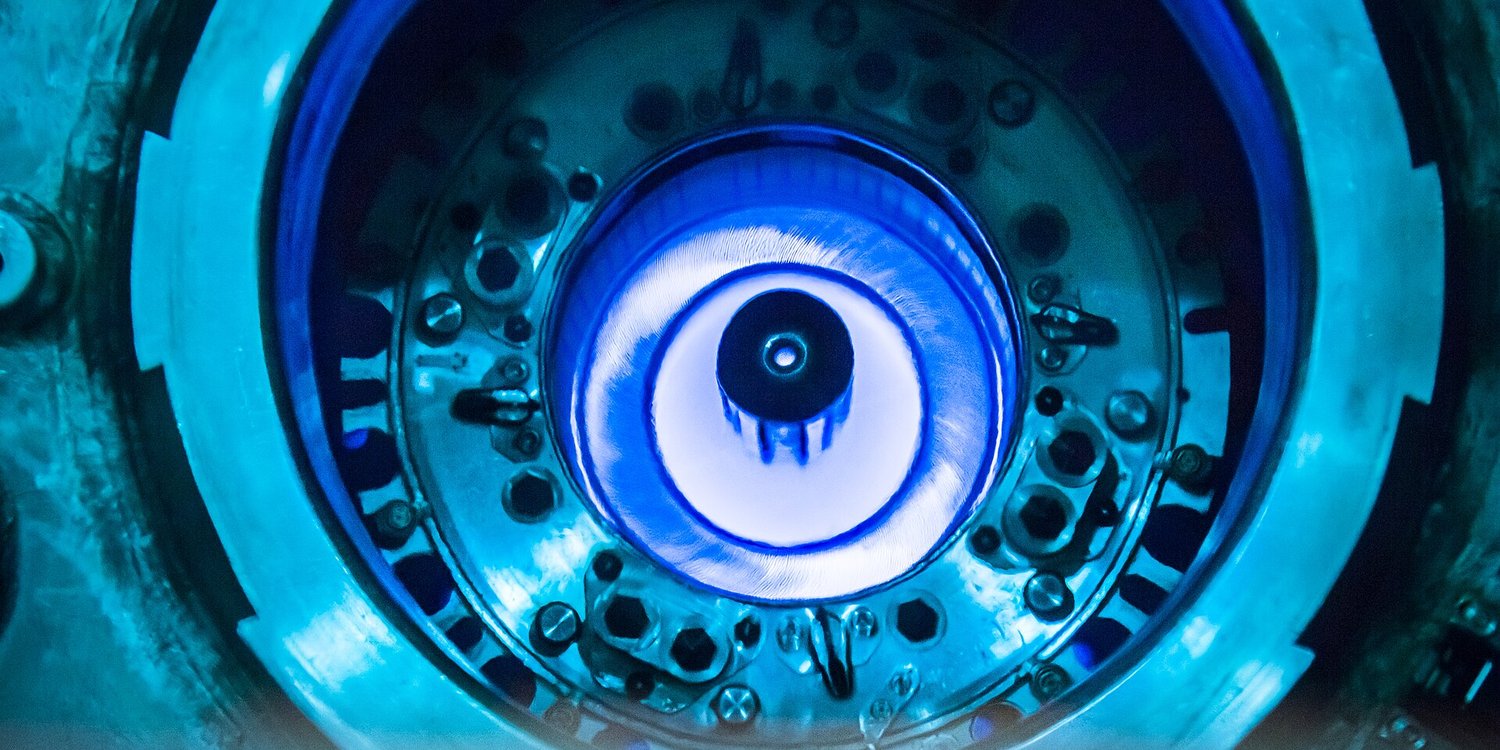
Fission is when nuclei of atoms split into several parts. In a reactor a neutron strikes a U-235 nucleus, the nucleus breaks into two fragments, and fresh neutrons fly out to hit the next nuclei, so the chain reaction sustains itself.
Plutonium-239 forms inside the fuel from U-238, and about one-third of the fuel’s energy yield comes from burning Pu-239.
A single fission yields over 200 million times the energy of the neutron that triggered it. In joules that’s about 3.2 x 10^-11 per fission, using NIST’s value for the electron volt.
That sounds tiny until you compare it with fire. Burning a carbon atom releases about 4 eV, so a fission carries about 50 million times as much energy as one burned atom.
Two parts of the core keep the pace steady. A moderator, which in US reactors is ordinary water, slows high-velocity neutrons so they’re more likely to split another nucleus. Control rods hold a material such as hafnium or boron that absorbs neutrons, and pushing the rods in slows the reaction while pulling them out speeds it up.
How much energy does one fuel pellet hold?
DOE says one uranium pellet produces as much energy as 1 ton of coal, and EIA puts it at the energy in 150 gallons of oil.
| One pellet equals | Amount | Source |
|---|---|---|
| Coal | 1 ton | DOE |
| Natural gas | 17,000 cubic feet | DOE |
| Oil | 120 gallons | DOE |
| Oil | 150 gallons | EIA |
Source: DOE, Nuclear by the Numbers, 2017 and EIA, Nuclear explained: Nuclear power plants.
The two agencies disagree on the oil figure, and neither page says why. They also describe the pellet differently. DOE’s sheet gives it as 0.3 inch wide and 0.5 inch long. The World Nuclear Association says pellets are usually about 1 cm wide and 1.5 cm long.
A large reactor needs a lot of them. A 1,000-megawatt-class PWR might hold 51,000 fuel rods with over 18 million pellets. Mining and enriching that fuel is its own industry, and natural uranium from ore is mostly U-238.
How is a pressurized water reactor different from a boiling water reactor?
In a pressurized water reactor the core water is held under pressure so it can’t boil, while in a boiling water reactor the water boils inside the reactor vessel, and more than 65% of US commercial reactors are the pressurized kind.
| PWR | BWR | |
|---|---|---|
| Where steam forms | Steam generator | Reactor vessel |
| Water loops | Primary and secondary | One |
| Fuel assemblies in the core | 150 to 200 | 370 to 800 |
| Units on NRC’s list (September 14, 2026) | 64 | 31 |
| Share of the 95 listed units (%) | 67.4 | 32.6 |
| Coolant and moderator | Light water | Light water |
Source: NRC, Pressurized Water Reactors, NRC, Boiling Water Reactors and NRC, List of Power Reactor Units. Shares are our calculation from the NRC counts.
In a PWR the water that boils is separate from the fission process, so the steam doesn’t become radioactive. In a BWR the steam leaves the core mixed with water droplets, and two stages of moisture separation dry it before it reaches the turbine.
NRC’s list has 95 units, one more than EIA’s count of 94, and the extra one is Palisades in Michigan.
How much of the heat becomes electricity?
The US nuclear fleet turned about a third of its heat into electricity in 2025, an efficiency of 32.7% calculated from EIA’s average heat rate of 10,443 Btu per kilowatt-hour.
| Fuel | Heat rate (Btu per kWh) | Efficiency (%) |
|---|---|---|
| Nuclear | 10,443 | 32.7 |
| Coal | 10,647 | 32.0 |
| Petroleum | 10,969 | 31.1 |
| Natural gas | 7,781 | 43.9 |
Source: EIA, Electric Power Annual, Table 8.1, 2025. Efficiency is 3,412 Btu divided by the heat rate, the method EIA gives.
Nuclear and coal plants land within a point of each other, because both boil water to spin a turbine. The World Nuclear Association says plants now being built run at about 34% to 36%, a bit above the fleet average, and that older ones run lower. Cooling-water temperature moves the number too.
The basis matters as well. Counting Vogtle Unit 4’s gross output of 1,250 megawatts instead of net output lifts its efficiency from 32.9% to 36.8%. The Union of Concerned Scientists puts the rule of thumb at about two units of waste heat for every unit of electricity.
What does one reactor like Vogtle Unit 4 produce?
When Unit 3 reached full power, Georgia Power said its output of about 1,100 megawatts could cover an estimated 500,000 homes and businesses. That homes figure is the company’s own estimate for one of the four units at the site.
EIA lists Unit 4 at 1,114 megawatts, a few megawatts below the owner’s figure, and doesn’t explain the gap.
Universities run reactors too, and NC State’s program, started in 1950, is built around a 1-MW research reactor. NC State describes the program’s mission as research, teaching and extension.
When did the reactors running today start up?
Of the 94 operating US reactors, 85 began operating in the 1970s or 1980s, according to EIA’s September 2026 generator inventory. If a reactor powers your home, odds are it started up in one of those two decades.
| Years began operating | US reactors |
|---|---|
| 1960 to 1969 | 1 |
| 1970 to 1979 | 41 |
| 1980 to 1989 | 44 |
| 1990 to 1999 | 5 |
| 2000 to 2009 | 0 |
| 2010 to 2019 | 1 |
| 2020 to 2026 | 2 |
Source: EIA, Preliminary Monthly Electric Generator Inventory (EIA-860M), September 2026. Counts are operating nuclear units by EIA’s operating year.
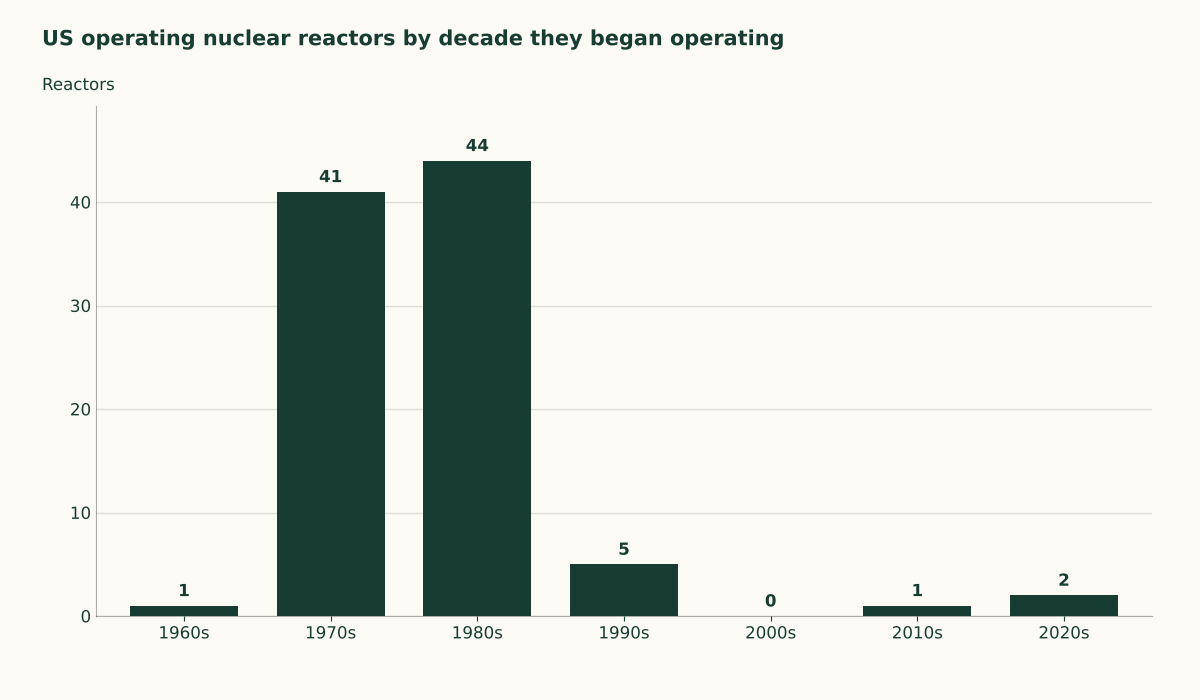
The fleet’s average age is about 44 years, and the oldest reactor, Nine Mile Point Unit 1 in New York, began commercial operation in December 1969. Several reactors can share one site, which is why the count of US nuclear power plants comes out lower than the reactor count.
If you live east of the Mississippi River, you’re in the region where most US reactors sit.
How often does a reactor stop to refuel?
US reactors typically refuel every 18 to 24 months, according to EIA, and the reactor is entirely shut down while it happens.
EIA’s 2019 count showed the stops getting shorter, with the average refueling outage falling from 46 days in 2012 to 32 days in 2019. Operators plan outages for the fall and spring, because demand is lowest when cooling and heating needs are modest, so the months when your furnace and air conditioner run least are the months a reactor is most likely to be offline.
Even with those stops, DOE found nuclear plants producing maximum power more than 92% of the time in 2020, and EIA’s 2025 figure was a 91% capacity factor. The capacity factor is the electricity a unit produced compared with what it could have produced at continuous full power.
Where does the leftover heat go?
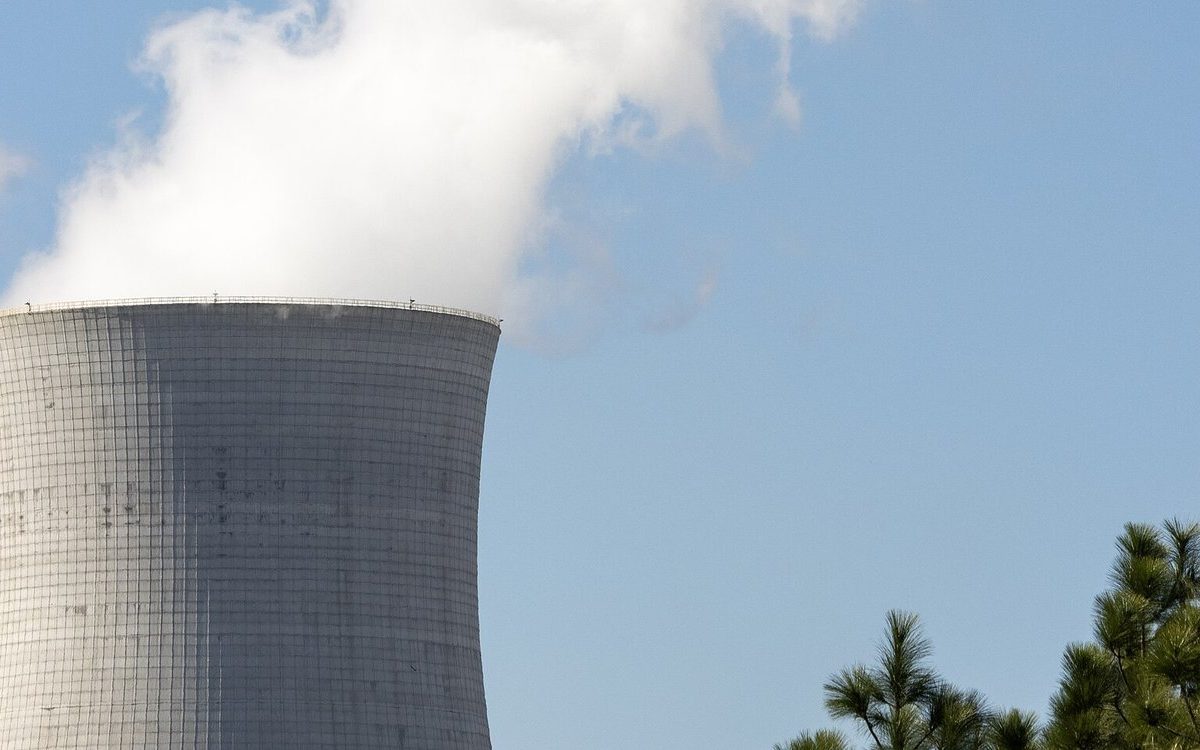
After the turbine, the unused steam goes to a condenser, where it is condensed into water, and the plant has to push that heat into air or water. Cooling doesn’t stop when the reactor does, because heat must continue to be removed after the reactor shuts down.
It’s the same energy lost as waste heat as at any steam plant, and a plant at 33% efficiency dumps about 14% more heat than one at 36%.
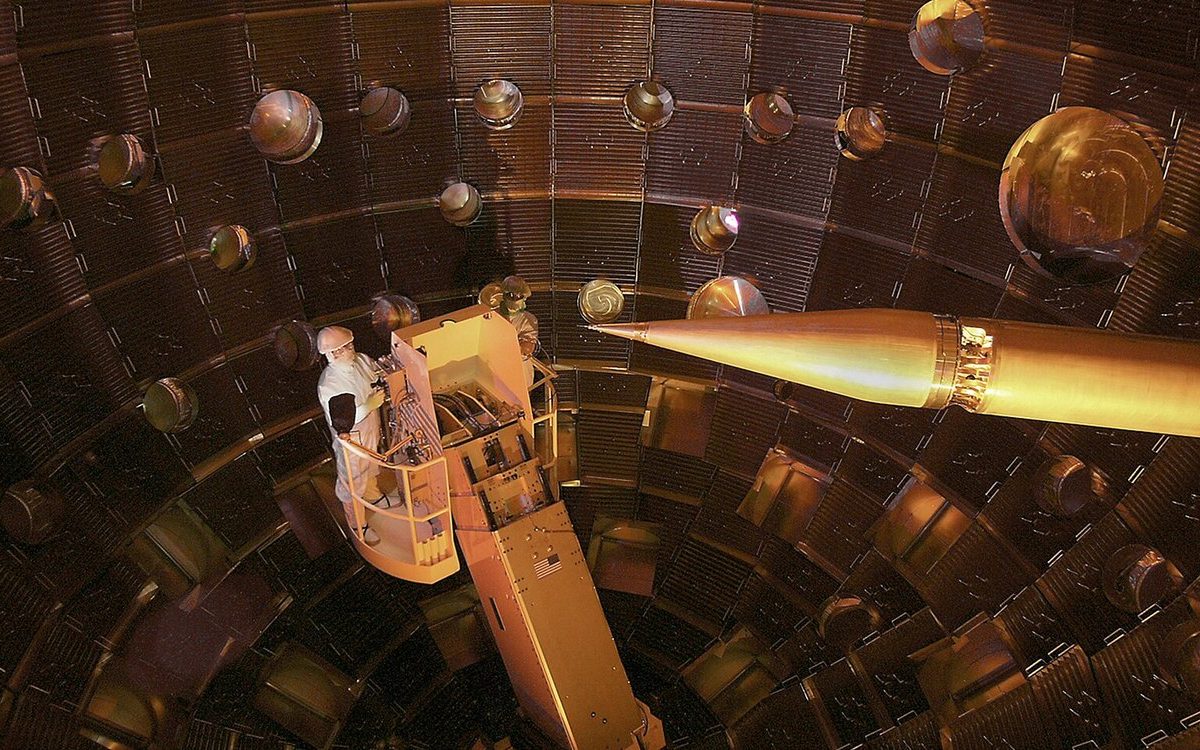
Whether nuclear power is safe is a separate question from how it works, and the numbers on nuclear safety answer it. Fusion power, the Sun’s reaction, is a different process, and EIA says all nuclear power plants use fission.
Where these numbers come from
We calculated three kinds of figures. Efficiency is 3,412 Btu divided by each fuel’s heat rate in EIA’s Table 8.1. The PWR and BWR shares are NRC’s unit counts divided by its total. The decade counts come from the Operating sheet of EIA’s generator inventory, filtered to nuclear units with a status of operating, which leaves out Palisades and Crane, both listed as out of service.
What 94 reactors add up to on your grid
Nuclear plants have generated about 20% of US electricity since 1990. Worldwide, nuclear supplied around 5% of primary energy in 2025, which counts heat and transport fuel as well as electricity.
Top photo: Oak Ridge National Laboratory, CC BY 2.0, via Wikimedia Commons, cropped.