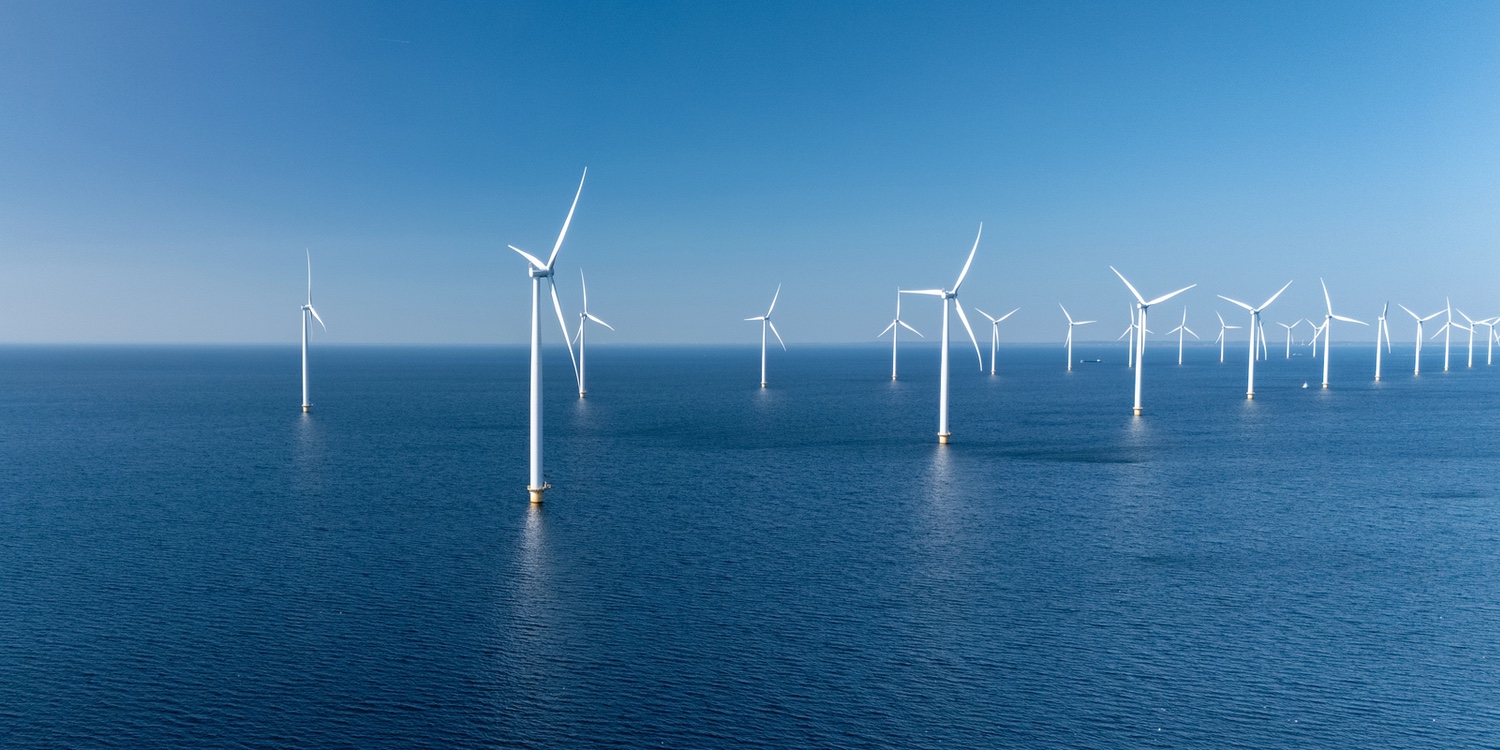
Offshore wind power comes from turbines standing in the ocean or floating above it, and the world had 92.5 gigawatts of it running by the end of 2025, within reach of the 100 gigawatt mark. The US has far less of it.
Its two offshore wind farms had a combined 304 megawatts running at the end of 2024. That adds up EIA’s separately reported 130 and 174 megawatt totals for South Fork Wind and Vineyard Wind 1. A new US project costs about $125 per megawatt-hour to build, and most of the ones under construction spent part of 2025 and 2026 under a federal stop-work order.
How a turbine in the ocean makes electricity
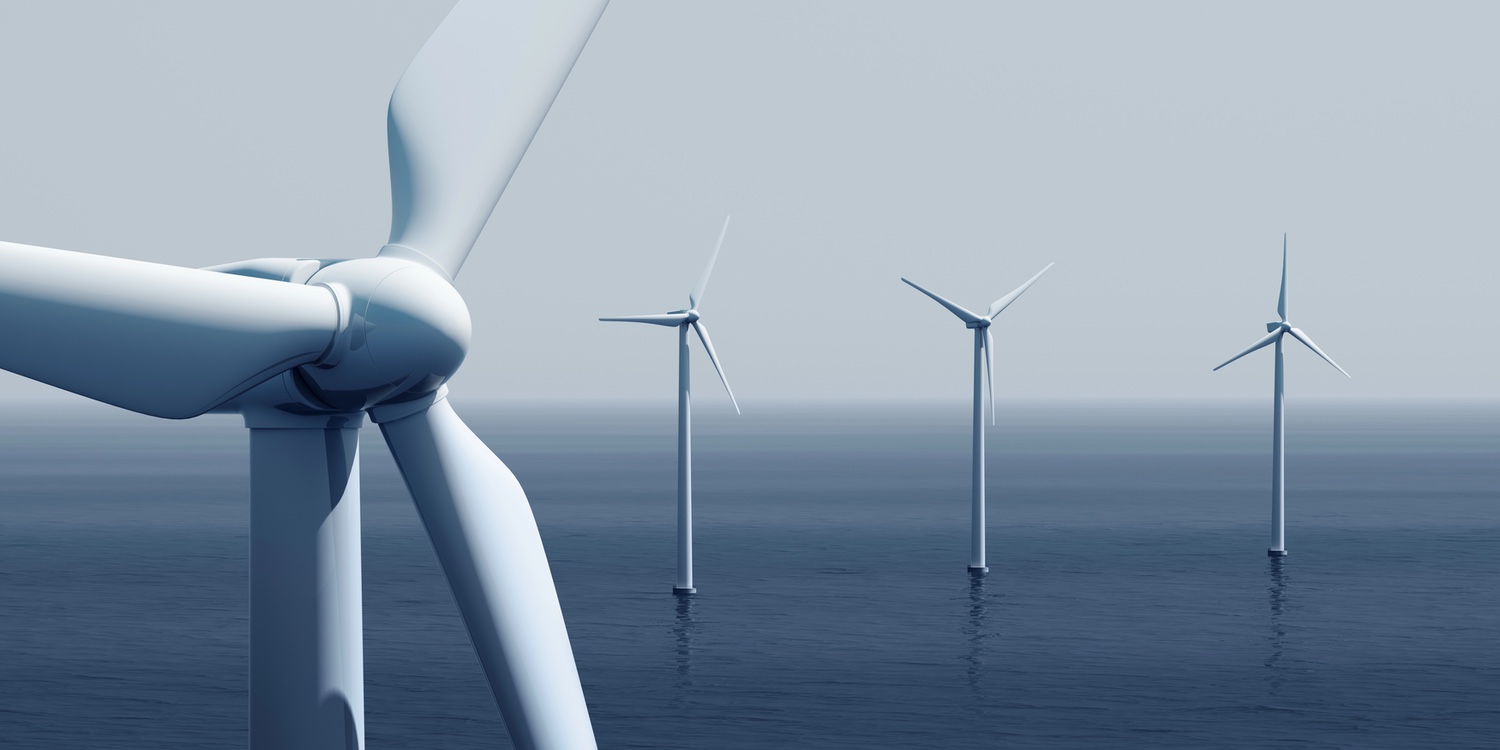
A turbine blade is shaped like an airplane wing turned on its side. Wind rushing over its curved face creates lift, and that force spins the rotor, which turns a shaft inside the nacelle and drives a generator. The current runs down the tower and out through a subsea cable buried in the seabed until it comes ashore.
Where the water is 30 meters deep or less, turbines usually stand on a gravity base or a single steel pile called a monopile, the cheapest and most common foundation worldwide. Between roughly 20 and 80 meters, developers switch to a four-legged jacket or a three-legged tripod. Past about 60 meters, the seabed drops away too fast for anything bolted to it, so floating turbines take over, sitting on barges, semi-submersibles, tension-leg platforms or spar buoys held in place by mooring lines in water as deep as 1,000 meters.
The payoff for building this far out is wind that blows harder and steadier than it does on land, with nothing like a hill or a building to slow it down.
How much offshore wind power the world has built
China did most of the building in 2025, commissioning 6.6 gigawatts while Europe added nearly 2 gigawatts across three markets. That capped a decade in which the global fleet grew by about 10% a year on average, spreading to 19 markets generating offshore wind power by the end of 2025. China alone runs more than half the world’s operating offshore capacity, with 41 gigawatts feeding its grid as of February 2025.
Turbines keep getting bigger too. The average machine installed worldwide in 2025 measured 10.3 megawatts, the first year that average topped 10 megawatts. Multiply that across a whole fleet and the global total could power the equivalent of 102 million homes for a year, homes like yours included if your utility buys any of that power.
How much offshore wind power the US has built
The US had two commercial offshore wind farms running at the end of 2024. South Fork Wind off Long Island runs at 130 megawatts, and Vineyard Wind 1 off Massachusetts was then partway built at 174 megawatts. That’s a rounding error next to the roughly 10% of US electricity that wind supplies overall. If your power comes off the Northeast grid, almost all of that wind is still onshore, generated far inland in Texas and the Great Plains.
The pipeline behind those two projects is much bigger than what’s built. Developers had reported plans for 80,523 megawatts of US offshore wind by May 2024, with 4,097 megawatts of it under construction at that point.
Construction picked up fast after that. Vineyard Wind 1 added 624 megawatts of turbines in 2025 and reached mechanical completion in the first quarter of 2026. Dominion Energy’s Coastal Virginia project, on its way to 2.6 gigawatts, had installed all 176 of its turbine foundations and was more than 60% built by January 2026.
What offshore wind costs
A new US offshore wind project ran about $125 per megawatt-hour in 2023 on an unsubsidized basis, with estimates ranging from $75 to $149 depending on the project. That’s more than 45% higher than the estimate in the prior year’s report.
The rest of the world has had an easier time bringing costs down. The global weighted-average cost of offshore wind fell 59% between 2010 and 2022, even as installed capacity grew twentyfold over the same period, to 63.2 gigawatts in 2022.
Federal tax credits are meant to help the US close that gap. The Inflation Reduction Act gives offshore wind developers a 30% investment tax credit, or a production tax credit worth $27.50 per megawatt-hour. Companies have announced or invested $10 billion in US supply chain projects since 2021, including $2.1 billion in 2023 alone.
Why so many US projects have stalled
The first wave of trouble was financial. Ørsted canceled its Ocean Wind 1 and 2 projects in New Jersey in late 2023, a combined 2,400 megawatts, citing higher interest rates and supply chain delays amid high inflation. The same developer also withdrew from the Skipjack 1 and 2 projects off Maryland, a combined 966 megawatts, while keeping their permits alive. By 2024, eight US projects had canceled their power purchase contracts for similar reasons, including SouthCoast Wind 1, New England Wind, Empire Wind 2 and Beacon Wind 1.
The second wave was political. President Trump signed a memorandum withdrawing federal waters from new wind leasing and pausing permit approvals on January 20, 2025, his first day back in office. BOEM followed with a stop-work order on Revolution Wind, off Rhode Island, in August 2025, when the project was already nearly 90% complete with 58 of its 65 turbines installed, then a stop-work order on five projects under construction in December 2025, adding Empire Wind, Sunrise Wind, Coastal Virginia and Vineyard Wind to the list.
The stated reason was national security concerns about the turbines interfering with military radar. Empire Wind alone was more than 60% built, would have powered 500,000 homes once finished and had about 1,000 people working on it when the order arrived. If you were one of those workers, or lived in one of those homes, the project’s finish date depended on a court date, not on the turbines themselves.
Federal judges reversed course in January 2026, ruling the stop-work orders unlawful for Empire Wind and Coastal Virginia, along with the Rhode Island project, and all three resumed construction. Vineyard Wind and Sunrise Wind were still waiting on their own court hearings at that point.
Vineyard Wind and Sunrise Wind are waiting on judges
Some developers stopped waiting on the courts. TotalEnergies gave up its leases off North Carolina and New York in March 2026 for a $928 million refund, and RWE relinquished three leases off New York, California and Louisiana in August 2026 for $1.22 billion, a little over $2 billion combined. Both companies chose to put that money into oil and gas projects instead. If you had capital tied up in a lease with no court date in sight, that trade, cash now over steel later, is the same one they made.
Sunrise Wind and Vineyard Wind didn’t have that option, since neither developer relinquished its lease. Both are still waiting on their own hearings, in the same courts that already cleared Empire Wind, Revolution Wind and Coastal Virginia to keep building. Until a judge rules, the two projects sit exactly where BOEM’s stop-work order left them.