The best portable power station for most people is the EcoFlow DELTA 3 Plus, which stores 1,024 Wh and refills from a wall outlet in 56 minutes. TechRadar named it the best overall pick, and at 27.6 lb it’s light enough to take camping. If you want the best portable power station for home backup, the EcoFlow DELTA Pro 3 holds four times the energy but weighs 114.1 lb. The seven picks below run from $299 to $2,799, the maker’s US store price for each in September 2026, and these brands discount often.
- EcoFlow DELTA 3 Plus for most people
- EcoFlow RIVER 3 Plus for small budgets and short outages
- EcoFlow DELTA Pro 3 for home backup
- Jackery Explorer 1000 v2 for camping
- Anker SOLIX F3800 Plus for the most output and the most room to add batteries
- Anker SOLIX C1000 Gen 2 for the fastest recharge
- DJI Power 1000 for creators who already use DJI gear
What makes a good portable power station
Every pick here is a lithium battery with its own inverter and outlets, the carry-it-yourself end of battery energy storage. Continuous output is the first number to check. It’s the wattage an inverter can hold indefinitely, and it has to cover everything you plug in at once. Surge is a burst, often a few seconds long, that gets a compressor or motor started, and Samlex’s inverter guide calls buying to the surge number a common sizing mistake. Capacity, in watt-hours, sets how long that output lasts.
All seven picks use lithium iron phosphate cells, written LiFePO4 or LFP. A peer-reviewed comparison on ScienceDirect puts that chemistry beyond 2,000 charge cycles, against 1,000 to 2,000 for nickel manganese cobalt (NMC) cells, which also lose capacity faster. EcoFlow rates the DELTA 3 Plus for 4,000 cycles before it falls below 80% capacity.
If you’ll recharge during a long outage or at a campsite, compare charge times and solar input. The 1 kWh units here claim full wall charges in 49 minutes to 1.58 hours, and solar input ranges from 220W to 3,200W. Weights go from 10.4 lb to more than 130 lb. Only some take add-on batteries. The DELTA 3 Plus grows to 5 kWh, while the Jackery stays at 1,070 Wh.
Check recall notices for your exact model, too. EcoFlow recalled the Delta Max 2000 in October 2025 over burn and fire risk. That notice covers model EFD310 and none of the EcoFlow units on this page.
The best portable power stations compared
| Product | Capacity (Wh) | Continuous output (W) | Weight | Store price | Best for |
|---|---|---|---|---|---|
| EcoFlow DELTA 3 Plus | 1,024 | 1,800 | 27.6 lb | $669 | Most people |
| EcoFlow RIVER 3 Plus | 286 | 600 | 10.4 lb | $299 | Small budgets, short outages |
| EcoFlow DELTA Pro 3 | 4,096 | 4,000 | 114.1 lb | $2,799 | Home backup |
| Jackery Explorer 1000 v2 | 1,070 | 1,500 | 23.8 lb | $559 | Camping |
| Anker SOLIX F3800 Plus | 3,840 | 6,000 | 132.3 to 136.7 lb | $2,599.99 | Expandable home backup |
| Anker SOLIX C1000 Gen 2 | 1,024 | 2,000 | 24.9 lb | $529.99 | Fastest recharge |
| DJI Power 1000 | 1,024 | 2,200 | 28.7 lb | $699 | DJI gear owners |
Source: specs from each maker’s product page, except the DELTA Pro 3’s weight, which OutdoorGearLab measured. Prices are each maker’s US store price in September 2026, and these brands discount often.
EcoFlow DELTA 3 Plus
For most households that want one unit for outages and weekends away.
The EcoFlow DELTA 3 Plus is our pick for most people, and it’s TechRadar’s best overall pick too. It stores 1,024 Wh in LiFePO4 cells and puts out 1,800W continuously, or 2,200W in EcoFlow’s X-Boost mode. A 1,500W wall charge fills it in 56 minutes, and its two solar inputs take up to 1,000W combined. When the grid drops, it switches to battery in under 10 milliseconds. You can grow it to 5 kWh with extra batteries later, and it carries a five-year warranty.
The catch is output. Its 1,800W continuous rating is half its 3,600W surge figure, and a 1,500W space heater running next to an 800W microwave needs 2,300W, more than even X-Boost’s 2,200W. On its own, that heater would drain the battery in about 41 minutes before conversion losses.
- Capacity: 1,024 Wh
- Output: 1,800W continuous, 3,600W surge
- Solar input: 1,000W
- Weight: 27.6 lb
- Price: $669
EcoFlow RIVER 3 Plus
A cheap backup you can carry anywhere, sized for a CPAP or a Wi-Fi router.
At $299 and 10.4 lb, the EcoFlow RIVER 3 Plus is the cheapest and lightest pick here. It holds 286 Wh in LiFePO4 cells rated for 3,000 cycles to 80% capacity, which EcoFlow puts at about 10 years of typical use. A wall charge takes about an hour, and like the DELTA 3 Plus, it switches to battery in under 10 milliseconds when the power cuts out.
Small, steady loads are what it’s built for. A ResMed AirSense 11 CPAP draws 56.1W in typical use, so 286 Wh runs it for about five hours before conversion losses. A Wi-Fi router averages about 10W, which stretches the same charge past 28 hours on paper. If that turns out to be too little, an EcoFlow extra battery raises the total to 858 Wh.
Its 600W continuous rating rules out an average 800W microwave or a 1,500W space heater. With solar input capped at 220W, it’s a unit for small electronics and short outages.
- Capacity: 286 Wh
- Output: 600W continuous, 1,200W surge with X-Boost
- Solar input: 220W
- Weight: 10.4 lb
- Price: $299
EcoFlow DELTA Pro 3
If you want the best portable power station for home backup and can leave it in one spot, start here.
OutdoorGearLab ran the EcoFlow DELTA Pro 3 through a runtime test, and its 4,096 Wh battery delivered 3,790 Wh, about 93% of the rating. OutdoorGearLab made it the top pick for home backup and ranked it second of the 14 units it tested, with a score of 81 out of 100. Its reviewers write that it powered almost every home essential during outages, including their fridge, lights, an electric kettle and a space heater.
Continuous output is 4,000W, and OutdoorGearLab measured an 8,000W surge. It takes up to 2,600W of solar, and in OutdoorGearLab’s charging test it refilled in 3.2 hours at 1,293 Wh per hour. One unit grows to 12 kWh with extra batteries, and three linked units reach 36 kWh. EcoFlow also sells it bundled with a 400W solar panel, and with 2,600W of solar input it’s our pick if you want the best solar generator for home backup.
It weighs 114.1 lb, and the wheeled cart is a separate accessory. OutdoorGearLab scored its portability 4.0 out of 10.
- Capacity: 4,096 Wh rated, 3,790 Wh in OutdoorGearLab’s test
- Output: 4,000W continuous, 8,000W surge
- Solar input: 2,600W
- Weight: 114.1 lb
- Price: $2,799
Jackery Explorer 1000 v2
For campers who want the lightest 1 kWh unit on this list.
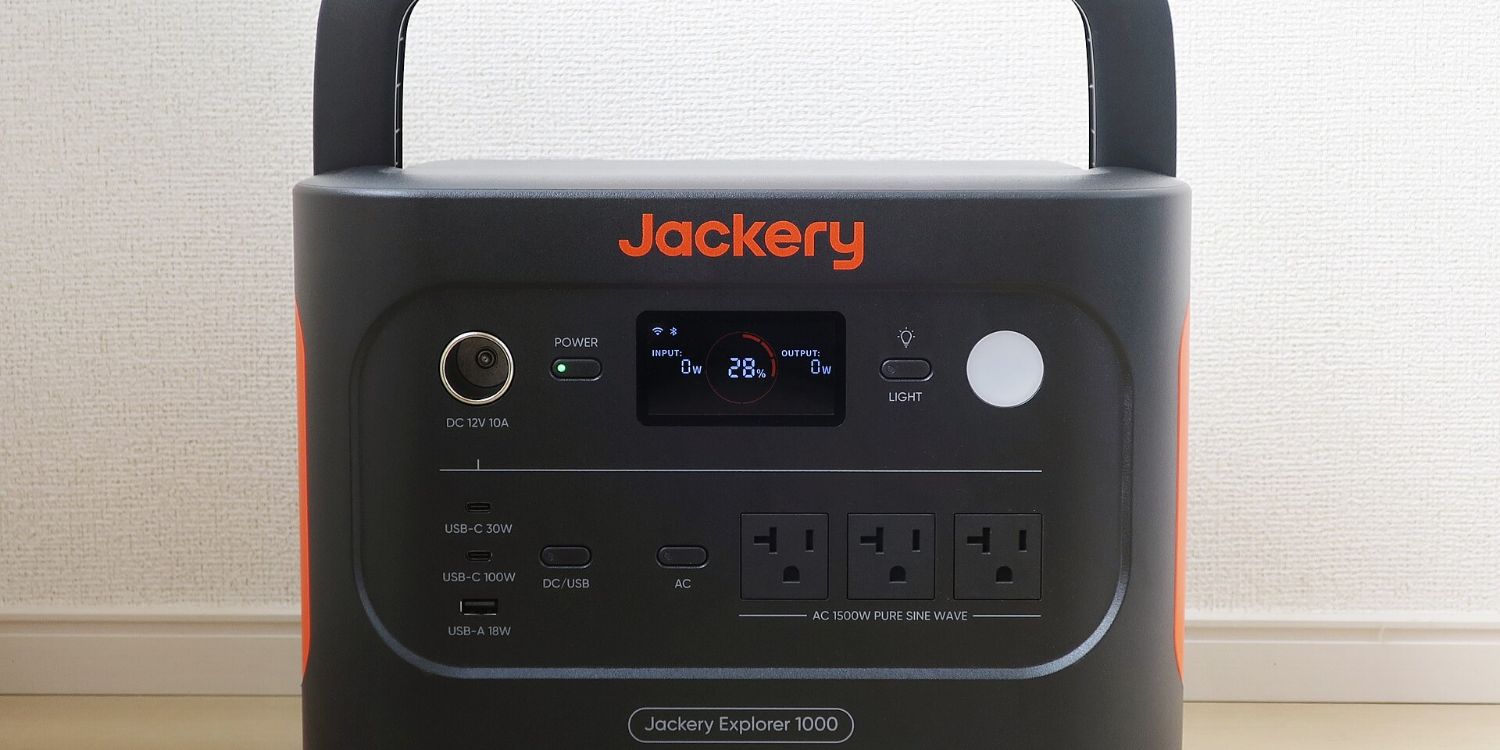
If you’re carrying power to a campsite, the Jackery Explorer 1000 v2 gives you 1,070 Wh at 23.8 lb, and it’s TechRadar’s pick as the best portable power station for camping. It puts out 1,500W continuously with a 3,000W surge, and a wall charge takes 1.58 hours. Its two 8mm DC ports take up to 400W of solar, and Jackery puts a recharge from one 200W panel at about 7.5 hours. Jackery rates the LiFePO4 cells for 4,000 cycles to 70% capacity, a lower bar than the 80% EcoFlow and Anker quote for their 1 kWh units.
In the usual Jackery vs EcoFlow matchup at this size, the Explorer is 3.8 lb lighter than the 27.6 lb DELTA 3 Plus and $110 cheaper than its $669 store price. The DELTA answers with 1,800W of continuous output to the Explorer’s 1,500W, and 1,000W of solar input to its 400W.
The Explorer can’t take an add-on battery, so 1,070 Wh is the ceiling unless you buy a second unit and pair the two.
- Capacity: 1,070 Wh
- Output: 1,500W continuous, 3,000W surge
- Solar input: 400W
- Weight: 23.8 lb
- Price: $559
Anker SOLIX F3800 Plus
The one to buy if you want the most output and plan to keep adding capacity.
Anker’s SOLIX F3800 Plus puts out 6,000W continuously, 2,000W more than the DELTA Pro 3. It stores 3,840 Wh on its own, and each expansion battery adds 3.84 kWh. TechRadar named the SOLIX F3800 its pick for RVs and home backup, citing a 26.9 kWh expansion ceiling, and Anker’s page for the Plus now lists up to 53.8 kWh.
Solar input reaches 3,200W across two inputs, and Anker says a solar recharge can take under two hours in strong sun. A wall outlet charges it at up to 1,800W. It switches to battery in 20 milliseconds on a 120V outlet and carries a five-year warranty.
Listed weights run from 132.3 to 136.7 lb, which makes it a stationary battery with a handle. Its $2,599.99 store price is lower than the DELTA Pro 3’s $2,799 even though it puts out more continuous power.
- Capacity: 3,840 Wh, expandable
- Output: 6,000W continuous
- Solar input: 3,200W
- Weight: 132.3 to 136.7 lb
- Price: $2,599.99
Anker SOLIX C1000 Gen 2
Pick this one if a fast recharge matters more to you than room to grow.
The reason to buy the Anker SOLIX C1000 Gen 2 is how fast it refills. Anker rates it at 49 minutes from empty to full on a 1,600W wall charge, the fastest full-charge claim on this list, and OutdoorGearLab timed it at 56 minutes. OutdoorGearLab named it the best value in its test, and GearJunkie rated it 9.4 out of 10 as its best overall pick under the name Solix C1000 V2.
It’s rated at 1,024 Wh, and OutdoorGearLab measured 890 Wh of usable output, about 87%. Output is 2,000W continuous with a 3,000W surge. It takes up to 600W of solar and switches to battery in 10 milliseconds. Anker’s 10-year warranty is twice the five years EcoFlow gives the DELTA 3 Plus.
It can’t take an expansion battery, so 1,024 Wh is all it will ever hold. Its $529.99 store price is $139 less than the DELTA 3 Plus, which can grow to 5 kWh.
- Capacity: 1,024 Wh, 890 Wh in OutdoorGearLab’s test
- Output: 2,000W continuous, 3,000W surge
- Solar input: 600W
- Weight: 24.9 lb
- Price: $529.99
DJI Power 1000
Made for creators already using DJI gear.
The other 1 kWh units here put out 1,500W to 2,000W continuously. The DJI Power 1000 manages 2,200W, with a 4,400W peak, from 1,024 Wh of LFP cells that DJI says keep at least 70% of their capacity after 4,000 cycles. It charges to 80% in about 50 minutes and to full in 70, and it takes up to 800W of solar from as many as six panels. Registering it extends the warranty to five years.
TechRadar’s pick for creators and drone users is the related Power 1000 Mini. The Power 1000 here is DJI’s current mainline US model.
Its SDC accessory ports use DJI’s proprietary format, which ties you to DJI’s own accessories. DJI also doesn’t state a switchover time for backup use, so for home backup an EcoFlow or Anker unit with a listed switchover time is the safer choice. At $699, it’s the most expensive 1 kWh unit on this list.
- Capacity: 1,024 Wh
- Output: 2,200W continuous, 4,400W peak
- Solar input: 800W
- Weight: about 28.7 lb
- Price: $699
How to size a portable power station
Watts are how fast an appliance draws power. Watt-hours are how much energy a battery holds, so dividing a battery’s watt-hours by the average watts of what you plug in gives you hours of runtime. The continuous output rating has to clear the highest draw you’ll hit at any one moment.
Say you want these running through an outage.
- A refrigerator with a 500W nameplate, which averages about 167W because it cycles on and off, per EnergySage
- A ResMed AirSense 11 CPAP, at 56.1W typical and 73.2W peak
- A Wi-Fi router, at about 10W
The averages add up to about 233W. The RIVER 3 Plus’s 286 Wh covers about 1.2 hours of that, and the DELTA 3 Plus’s 1,024 Wh about 4.4 hours. On its rated 4,096 Wh, the DELTA Pro 3 would last about 17.6 hours.
You won’t get every rated watt-hour out of the outlets. OutdoorGearLab measured 3,790 Wh from the DELTA Pro 3, about 93% of its rating, and 890 Wh from the C1000 Gen 2, about 87%. Two tests from one reviewer don’t make a rule, but at the DELTA Pro 3’s measured figure the same load runs about 16.3 hours.
For output, add the fridge’s 500W nameplate to the other two peaks, which gives about 583W. That fits under even the RIVER 3 Plus’s 600W continuous rating, and the fridge compressor’s startup kick is what the surge rating is for, per Samlex. Plug in an 800W microwave too and the peak jumps to about 1,383W, past the RIVER 3 Plus but inside the Jackery’s 1,500W. Add a 900W window AC on top and you need about 2,283W, which only the DELTA Pro 3 and F3800 Plus can supply.
When a home battery makes more sense
At EnergySage’s 167W average, a fridge alone uses about 4,000 Wh a day. That’s close to the DELTA Pro 3’s entire 4,096 Wh rating and more than the 3,790 Wh OutdoorGearLab measured from it. Add the Wi-Fi router from the example above and a full day comes to about 4,250 Wh, more than any single unit here holds without expansion batteries, and that’s before adding a CPAP overnight.
The two units that can grow past that, the DELTA Pro 3 and the F3800 Plus, already weigh 114.1 lb and more than 130 lb before you add a battery. If you’re planning for outages that last days, or for loads like a 1,500W space heater, a home battery installed at the house is worth pricing against a stack of expansion packs. Our home battery backup guide compares those systems and what they cost to install.
