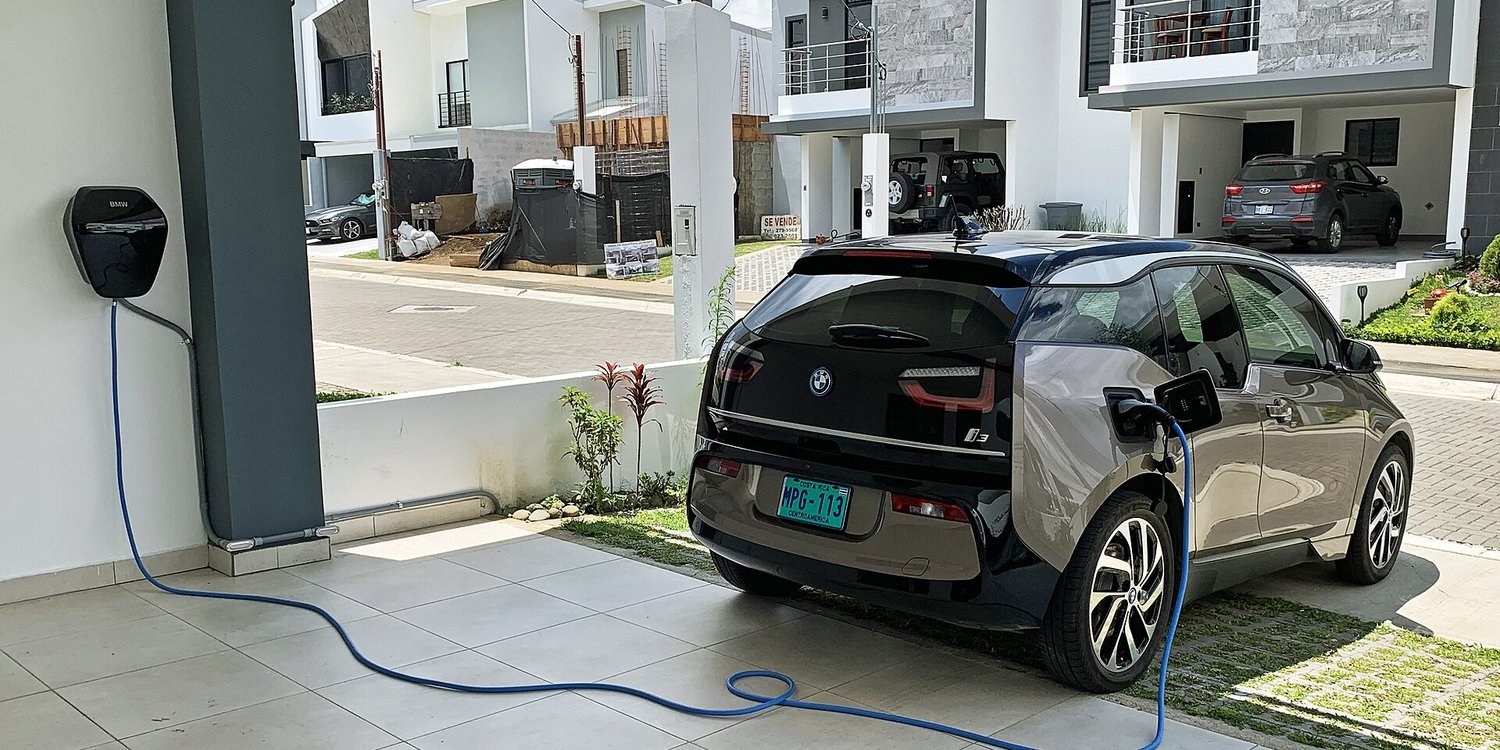
A 2026 Chevrolet Equinox EV costs about $5.65 per 100 miles to charge at home, using the US residential average of 18.19 cents per kWh from January to July 2026. The EPA rates it at 31 kWh per 100 miles. The gas Chevrolet Equinox, rated 27 mpg, costs about $16.54 over the same distance at $4.465 a gallon, EIA’s regular price for the week of September 28, 2026. Your own cost depends on your state, your rate plan and where you plug in, and the tables below show how much each one moves it.
Top electric car charging cost statistics
- A 2026 Tesla Model Y Long Range RWD, rated at 25 kWh per 100 miles, costs about $4.59 to cover that distance at home at the US average price for January to July 2026.
- A 2026 Kia EV9 Long Range AWD, rated at 40 kWh per 100 miles, costs about $7.28 for the same distance.
- US households paid an average of 17.30 cents per kWh for electricity in 2025.
- July 2026 alone averaged 18.31 cents per kWh for US residential customers.
- EIA’s September 2026 outlook forecasts a residential price of 18.2 cents per kWh for 2026 and 18.6 for 2027.
- Public DC fast chargers averaged $0.53 per kWh in the first quarter of 2026, according to Paren.
- The average new 2024 vehicle gets 27.2 mpg in real-world driving, a record, according to EPA.
- J.D. Power’s 2026 owner survey found that 86% of typical EV charging happens at home.
- Electrify America says a Pass+ membership saves about 25% on charging.
How much does it cost to charge an electric car at home?
Home charging costs about $5.46 per 100 miles for a Nissan Leaf, which the EPA rates at 30 kWh over that distance. Across the seven 2026 EVs in the table it runs from $4.48 for the Tesla Model 3 to $7.28 for the Kia EV9 at the January to July 2026 US average price.
| Model (2026) | Energy use (kWh/100 mi) | EPA range (mi) | Home cost per 100 mi at 18.19 cents ($) | Energy for full range (kWh) | Home cost for full range ($) |
|---|---|---|---|---|---|
| Tesla Model 3 Premium RWD | 24.6 | 363 | 4.48 | 89.4 | 16.27 |
| Tesla Model Y Long Range RWD | 25.2 | 357 | 4.59 | 90.1 | 16.38 |
| Hyundai Ioniq 5 RWD | 30.0 | 318 | 5.46 | 95.4 | 17.35 |
| Nissan Leaf 75 kWh | 30.0 | 288 | 5.46 | 86.4 | 15.72 |
| Ford Mustang Mach-E RWD Extended | 30.7 | 320 | 5.58 | 98.1 | 17.85 |
| Chevrolet Equinox EV FWD | 31.1 | 319 | 5.65 | 99.1 | 18.03 |
| Kia EV9 Long Range AWD | 40.0 | 283 | 7.28 | 113.2 | 20.59 |
Source: EPA ratings from fueleconomy.gov for the Tesla Model 3, Tesla Model Y, Hyundai Ioniq 5, Nissan Leaf, Ford Mustang Mach-E, Chevrolet Equinox EV and Kia EV9, priced at the January to July 2026 US residential average from EIA. Costs are calculated from these sources.
The two Teslas sit at the low end of the table for energy use and the Kia at the high end.
A Nissan Leaf, with an EPA range of 288 miles, needs about $15.72 of electricity to cover it at the same price. A Ford Mustang Mach-E, rated at 320 miles, needs about $17.85.
J.D. Power’s 2026 owner survey found that EV owners spent an average of $63 on home charging in the past 30 days, up $5 from a year earlier.
How much does it cost to charge an electric car in your state?
From January to July 2026, US households paid 12.36 cents per kWh in North Dakota and 46.28 in Hawaii, the lowest and highest state prices in EIA’s table, so the same car costs different amounts to charge from place to place.
| State | Home price, Jan to Jul 2026 (cents/kWh) | Model Y per 100 mi ($) | Equinox EV per 100 mi ($) | Equinox EV full range ($) |
|---|---|---|---|---|
| North Dakota | 12.36 | 3.12 | 3.84 | 12.25 |
| Nebraska | 12.90 | 3.25 | 4.01 | 12.79 |
| Idaho | 12.96 | 3.27 | 4.03 | 12.85 |
| Utah | 13.16 | 3.32 | 4.09 | 13.05 |
| Louisiana | 13.35 | 3.37 | 4.15 | 13.23 |
| Florida | 15.30 | 3.86 | 4.75 | 15.17 |
| Texas | 16.06 | 4.05 | 4.99 | 15.92 |
| US average | 18.19 | 4.59 | 5.65 | 18.03 |
| New York | 29.38 | 7.41 | 9.13 | 29.13 |
| Maine | 29.99 | 7.57 | 9.32 | 29.73 |
| Massachusetts | 30.14 | 7.60 | 9.37 | 29.88 |
| California | 33.25 | 8.39 | 10.33 | 32.96 |
| Hawaii | 46.28 | 11.67 | 14.38 | 45.88 |
Source: EIA, Electric Power Monthly, Table 5.6.B, with EPA ratings for the Tesla Model Y and the Chevrolet Equinox EV from fueleconomy.gov. Costs are calculated from these sources.
EIA says electricity prices vary by locality with the availability of power plants and fuels, local fuel costs and pricing regulations. Florida and Texas sit below the US average in the table.
Plug an Equinox EV in at a Hawaii address and 100 miles costs about $14.38, against $3.84 in North Dakota.
J.D. Power’s owner survey found regional differences in spending too, with New England owners at $99 and Mountain-region owners at $36 over 30 days.
How much does it cost to charge an electric car at a public charging station?
DC fast chargers averaged 53.8 cents per kWh across the US in the second quarter of 2026, according to Paren’s quarterly report. The table prices that and other options for a Chevrolet Equinox EV, with the gas Equinox at EIA’s gasoline price for comparison.
| Where and how | Price (cents/kWh) | Equinox EV per 100 mi ($) | Equinox EV full range ($) |
|---|---|---|---|
| Georgia Power overnight plan | 2.1859 | 0.68 | 2.17 |
| PG&E EV2-A, summer lowest-cost hours | 23 | 7.15 | 22.80 |
| EVgo Level 2, select locations | 28 | 8.70 | 27.76 |
| Georgia Power on-peak, summer weekdays | 29.7868 | 9.26 | 29.53 |
| Supercharger, Tesla owner, Los Angeles peak | 45 | 13.98 | 44.61 |
| DC fast, US average, Q2 2026 | 53.8 | 16.72 | 53.33 |
| PG&E EV2-A, summer 4 to 9 p.m. | 54 | 16.78 | 53.53 |
| Supercharger, non-member, Los Angeles peak | 60 | 18.65 | 59.48 |
| DC fast, Hawaii average, Q2 2026 | 85.6 | 26.60 | 84.86 |
| Gasoline, 27 mpg Equinox, $4.465 a gallon | n/a | 16.54 | n/a |
Source: Georgia Power, PG&E, EVgo, Electrek on Tesla Supercharger pricing, Paren, Q2 2026 and EIA weekly gasoline prices, with EPA ratings for the Chevrolet Equinox EV and the Chevrolet Equinox. Costs are calculated from these sources. The Georgia Power, PG&E, EVgo and Tesla rows each describe one plan, network or city.
At the Paren average, DC fast charging an Equinox EV costs about the same per mile as running the gas Equinox.
Electrek reports that at peak hours at Los Angeles Superchargers, non-Tesla drivers pay about $0.60 per kWh and Tesla owners $0.45. A $12.99 monthly membership gives non-Tesla EVs the Tesla rate.
Electrify America says DC fast prices depend on the charger’s location, your plan and the energy delivered, and its Pass+ membership saves about 25%. Its page gives no flat per-kWh price.
EVgo lists Level 2 charging at $0.28 per kWh in select locations and adds a $2.99 fee to sessions started with a credit card.
Hawaii was the most expensive state for fast charging in that quarter, as it is for home electricity.
Is charging an electric car cheaper than buying gas?
Driving 100 miles costs about $5.65 in the Equinox EV and about $16.54 in the gas Equinox, going by the EPA’s side-by-side ratings at the January to July 2026 home average and EIA’s September 28 gasoline price. EPA’s Automotive Trends Report puts the average new 2024 vehicle at 27.2 mpg in real-world driving, close to the gas Equinox’s rating.
Those prices cover different periods, and gasoline has moved fast. EIA’s weekly series had regular at $4.085 on August 24, 2026 and at $4.465 five weeks later.
Home electricity rose from 12.55 cents per kWh in 2016 to 17.30 cents in 2025. Regular gasoline went from $2.143 to $3.097 a gallon over the same years.
| Year | Home electricity (cents/kWh) | Regular gasoline ($/gal) | Equinox EV per 100 mi ($) | Gas Equinox per 100 mi ($) |
|---|---|---|---|---|
| 2015 | 12.65 | 2.429 | 3.93 | 9.00 |
| 2016 | 12.55 | 2.143 | 3.90 | 7.94 |
| 2017 | 12.89 | 2.415 | 4.01 | 8.94 |
| 2018 | 12.87 | 2.719 | 4.00 | 10.07 |
| 2019 | 13.01 | 2.604 | 4.04 | 9.64 |
| 2020 | 13.15 | 2.168 | 4.09 | 8.03 |
| 2021 | 13.66 | 3.008 | 4.25 | 11.14 |
| 2022 | 15.04 | 3.951 | 4.67 | 14.63 |
| 2023 | 16.00 | 3.519 | 4.97 | 13.03 |
| 2024 | 16.48 | 3.304 | 5.12 | 12.24 |
| 2025 | 17.30 | 3.097 | 5.38 | 11.47 |
Source: EIA, Electric Power Monthly, Table 5.3, EIA, Electric Power Annual, Table 2.4 for 2015, EIA regular gasoline annual prices, and 2026 EPA ratings for the Chevrolet Equinox EV and the Chevrolet Equinox. Prices are nominal dollars. Costs are calculated from these sources.
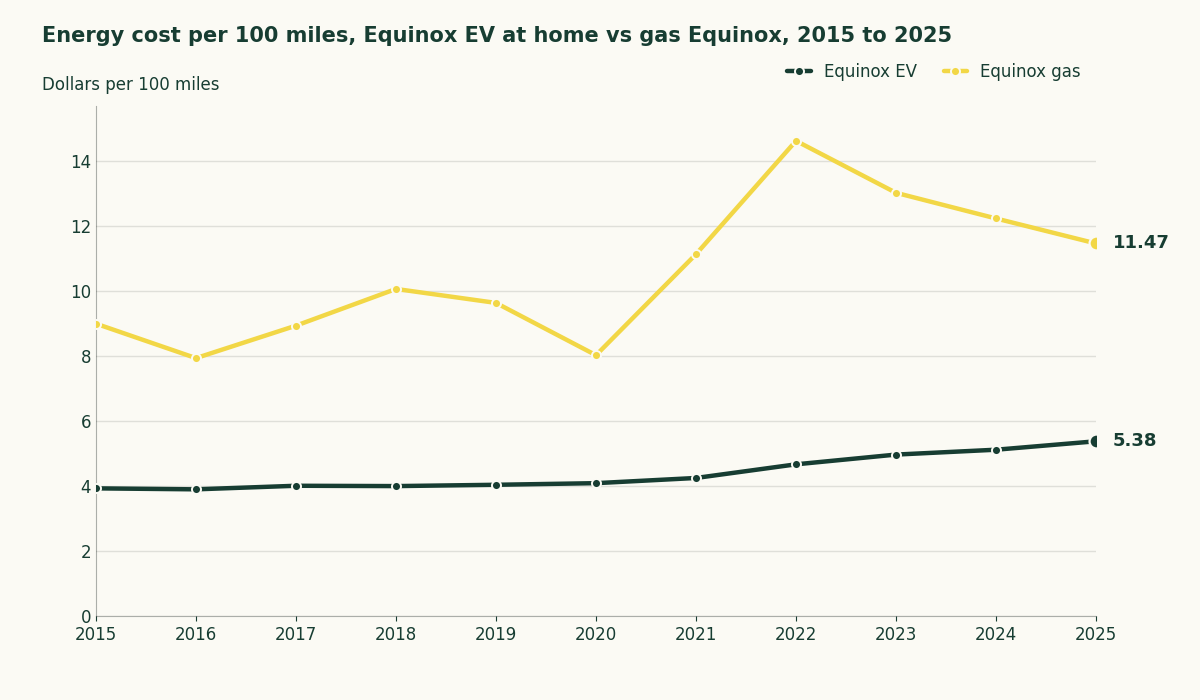
The gas Equinox’s cost per 100 miles peaked in 2022, when regular averaged $3.951 a gallon.
We computed each cost by multiplying an energy rate by a price. For electric cars that’s the EPA energy rating times the price per kWh, and for the gas Equinox it’s the price per gallon divided by its miles per gallon. The history table holds the 2026 ratings fixed and varies the prices, so it shows what each year’s prices would have cost a 2026 car. Electricity is an average over a span of months and gasoline is a single week, which is why the comparison at the top of this section names both dates.
For more on the vehicles themselves, see the pages on electric vehicle sales and natural gas vehicles in the US.
How much electricity does it take to charge an electric car?
A Tesla Model Y Long Range RWD uses 25 kWh of electricity per 100 miles under its 2026 EPA rating. A kilowatt-hour is the energy your bill charges for, and a kilowatt is how fast a charger delivers it.
Level 1 charging adds about 5 miles of range per hour, according to the Department of Energy. Level 2 adds about 25 miles per hour. DC fast charging adds 100 to 200+ miles per 30 minutes.
Some energy is lost on the way to the battery. fueleconomy.gov’s EV technology page says battery charging efficiency is often 84% to 93%. A peer-reviewed measurement study found one-way losses of 12% to 36% in its test setups.
Battery size is a different number again. KBB lists the Hyundai Ioniq 5 at 84 kWh. The EPA rating works out to 95.4 kWh over that car’s 318-mile range. Check which figure a review or your car’s screen is quoting before you compare prices.
How can you pay less to charge an electric car?
The hour you plug in changes the price on a time-of-use plan. PG&E’s EV2-A plan charges 23 cents per kWh in summer from midnight to 3 p.m. Between 4 p.m. and 9 p.m. the price reaches 54 cents.
Georgia Power’s Overnight Advantage plan lists 2.1859 cents per kWh from 11 p.m. to 7 a.m. On summer weekday afternoons the on-peak price is 29.7868 cents. The page gives per-kWh rates and doesn’t say whether other charges apply, so the plan’s price on your full bill may differ.
Ask your utility whether it offers an EV or time-of-use plan, and compare its overnight price with your current rate. Drivers who also want power during outages can read our page on home battery backup.
What EIA’s outlook says about home power and gasoline in 2027
EIA’s September 2026 outlook forecasts a US residential price of 18.2 cents per kWh for 2026 and 18.6 for 2027. It forecasts retail gasoline at $3.84 a gallon in 2026 and $3.35 in 2027. The next outlook is due October 6, 2026.
To price your own car, take its energy use per 100 miles from the Find a Car page on fueleconomy.gov and multiply by the cents per kWh on your power bill, which gives your cost for that distance in cents.
Top photo: Mariordo (Mario Roberto Durán Ortiz), CC BY-SA 4.0, via Wikimedia Commons, cropped.