US data centers consumed 66 billion liters of water on site in 2023, mostly to cool servers, and the power plants behind their electricity consumed nearly 800 billion liters more, Lawrence Berkeley National Laboratory (LBNL) estimates. Nobody publishes how much of that is AI. The public AI numbers are per-prompt estimates, and they run from 0.26 milliliters to 45 milliliters depending on what gets counted. The figures come mostly from LBNL and company environmental reports and describe 2023 to 2025 unless a line says otherwise.
Top data center water usage statistics
- LBNL estimates US data centers consumed 66 billion liters directly in 2023, up from 21.2 billion in 2014.
- The electricity those data centers used in 2023 took nearly 800 billion liters at power plants, according to the same lab.
- Google’s data centers and offices consumed 10.9 billion gallons of water in 2025, up 34% on 2024.
- Amazon reports a global water use effectiveness of 0.12 liters per kWh in 2025, down from 0.25 in 2021.
- Google says its median Gemini text prompt used 0.26 milliliters of water in May 2025, counting cooling water only.
- A UC Riverside study found GPT-3 uses a 500 milliliter bottle of water per 10 to 50 responses, including power plant water.
- Mistral’s life-cycle analysis put a 400-token Le Chat response at 45 milliliters of water.
- A peer-reviewed study in Nature Sustainability projects US AI servers will have a water footprint of 731 to 1,125 million cubic meters a year between 2024 and 2030.
How do data centers use water?
Water gets counted in two different ways. Withdrawal is what a site pulls from a river, an aquifer or a city main. Consumption is the part that doesn’t go back, and Google calculates it as withdrawal minus discharge.
Direct water is what the building uses, mostly in cooling systems that let water evaporate to carry heat out. Indirect water is what power plants consume to make the electricity the building runs on. Every figure below says which one it counts.
How much water do US data centers use?
LBNL’s 2024 report puts direct use at 66 billion liters in 2023, with hyperscale and colocation sites making up 84% of it and companies’ own server rooms down to 12%.
| Measure | Year | Water consumed (billion liters) |
|---|---|---|
| Direct, on site | 2014 | 21.2 |
| Direct, on site | 2023 | 66 |
| Indirect, power plants | 2023 | about 800 |
| Direct, hyperscale only (projection) | 2028 | 60 to 124 |
Source: Lawrence Berkeley National Laboratory, 2024 United States Data Center Energy Usage Report. The indirect figure uses the regional grid mix around each data center.
The electricity side is the bigger one. A kilowatt-hour for a data center carried 4.52 liters of indirect water in 2023, against 4.35 for the average US kilowatt-hour, so the water in your own electricity is close behind. Where that power comes from sets the number, and AI demand on the grid is pushing the electricity total up.
For scale, 17 billion gallons of direct use a year, as reported from the same LBNL study, is about 47 million gallons daily. USGS counted 322 billion gallons a day withdrawn for all US uses in 2015. USGS counts withdrawals and LBNL counts consumption, so the two don’t line up. Hydraulic fracturing is another heavy industrial draw, covered in water used in fracking.
How much water does one data center use?
A data center with 15 megawatts of IT capacity and cooling towers consumed 80 to 130 million gallons a year in LBNL’s 2016 estimate, which used a flat cooling assumption. Real sites vary far more, and operators report withdrawal at individual sites in megaliters, where one megaliter is a million liters.
| Site | Operator | Period | Water withdrawn (megaliters) |
|---|---|---|---|
| Clonee, Ireland | Meta | 2024 | 571 |
| Forest City, North Carolina | Meta | 2024 | 16 |
| Boydton, Virginia | Microsoft | Fiscal 2025 | 362 |
| Singapore | Microsoft | Fiscal 2025 | 423 |
| Dublin, Ireland | Microsoft | Fiscal 2025 | 18 |
Source: Meta, 2025 Environmental Data Index and Microsoft, 2026 Environmental Data Fact Sheet. Microsoft’s fiscal year ends June 30. Both companies report withdrawal at sites and leave consumption out.
At the top end, the nonprofit EESI says the largest data centers can consume up to 5 million gallons a day, the water use of a town of 10,000 to 50,000 people.
In The Dalles, Oregon, Google’s data centers consumed 355 million gallons in 2021, 29% of the city’s total water consumption. If a campus is proposed in your town, ask what share of the local supply it would take.
What do Microsoft, Meta and Amazon report?
Each company reports a different slice of its water. Microsoft gave 8,170 megaliters of consumption for fiscal 2025 across all its operations, and Meta gave withdrawal only.
| Company | Measure | Period | Water (megaliters) |
|---|---|---|---|
| Microsoft | Consumption, all operations | Fiscal 2025 | 8,170 |
| Microsoft | Withdrawal, all operations | Fiscal 2025 | 13,266 |
| Meta | Withdrawal, own data centers | 2024 | 4,145 |
| Meta | Withdrawal, leased data centers | 2024 | 883 |
| Meta | Withdrawal, whole company | 2024 | 5,637 |
Source: Microsoft, 2026 Environmental Data Fact Sheet, Table 8, and Meta, 2025 Environmental Data Index. Meta’s data center row excludes 1,019 megaliters withdrawn to build data centers, and Microsoft estimates datacenter water from efficiency metrics starting in fiscal 2024.
Amazon’s report gives an efficiency ratio and no total, which is why it has no row here.
How much water does Google use?
The 2026 report gives consumption in gallons for each year since 2021, and the table shows it rose every year. Roughly three-quarters of the water Google withdraws is consumed, going by the two columns.
| Year | Withdrawal (million gallons) | Consumption (million gallons) |
|---|---|---|
| 2021 | 6,297 | 4,562 |
| 2022 | 7,600 | 5,565 |
| 2023 | 8,653 | 6,352 |
| 2024 | 11,011 | 8,135 |
| 2025 | 14,689 | 10,869 |
Source: Google, 2026 Environmental Report, data tables. Covers Google-owned and operated data centers and offices, and excludes third-party data centers.
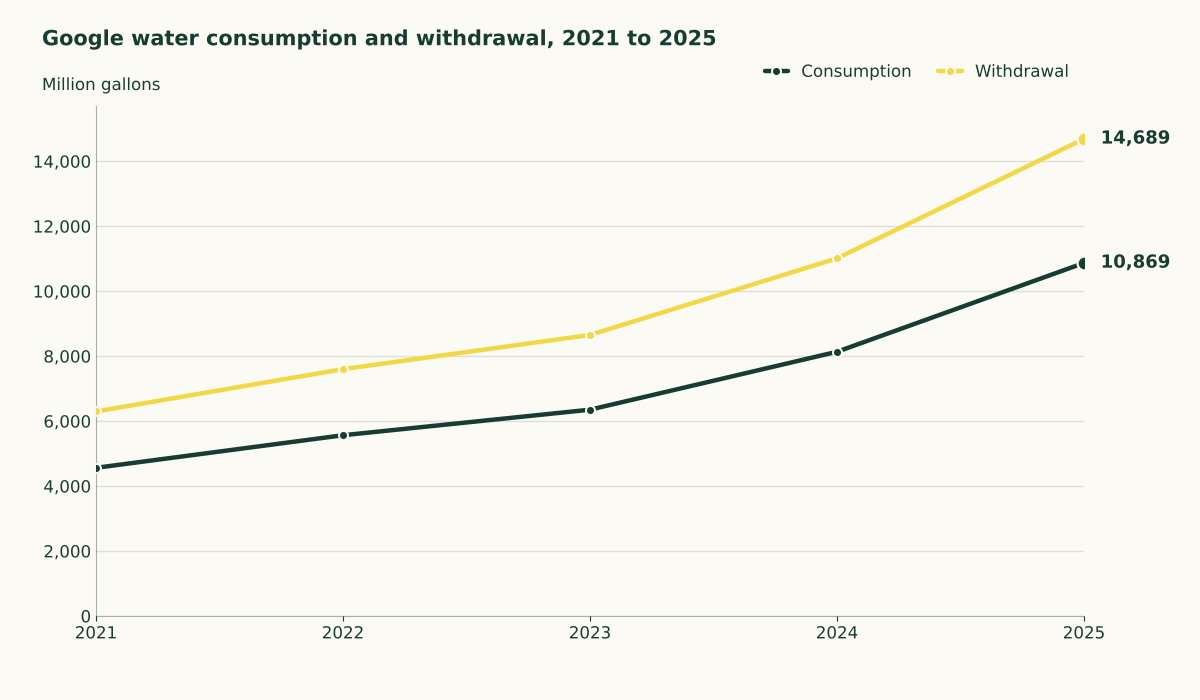
In its 2025 report, Google likened 2024 consumption to the water 54 golf courses in the US Southwest use in a year.
How much water does one AI prompt use?
Google says the median Gemini Apps text prompt used 0.26 milliliters of water in May 2025, about five drops. It’s the smallest figure in the table, and the others sit well above it.
| Estimate | Water per prompt | What it counts |
|---|---|---|
| Google, median Gemini text prompt, May 2025 | 0.26 mL | Data center cooling water |
| OpenAI’s Sam Altman, average ChatGPT query | 0.000085 gallons | No method given |
| Mistral, 400-token Le Chat response | 45 mL | Life cycle, including upstream |
| UC Riverside, GPT-3 response, US average | 2.2 mL | On-site cooling water |
| UC Riverside, GPT-3 response, US average | 16.9 mL | Cooling plus power plant water |
Source: Google, Sam Altman’s blog, Mistral AI and Li et al., Making AI Less Thirsty.
Mistral’s figure is more than two orders of magnitude above Google’s, dividing one by the other. Google’s figure is the cooling water for the energy a prompt uses, at its fleetwide water use effectiveness. Mistral ran a life-cycle analysis, so it counts more than the data center.
The UC Riverside figure adds power plant water, so it moves with location. The same GPT-3 response needed 7.6 milliliters in Texas and 29.9 in Arizona. Altman gave no method for his figure, so it counts as a statement from a chief executive and not a measurement. If you use an assistant every day, which number applies depends on where its maker draws the boundary.
What share of data center water is AI?
No operator or agency publishes AI’s share of data center water. The one US estimate that isolates AI servers is a projection of 731 to 1,125 million cubic meters a year between 2024 and 2030, counting cooling and electricity, depending on how fast servers go in.
A million cubic meters is a billion liters. LBNL’s 2023 total for all data centers, 66 billion liters direct plus about 800 billion indirect, is about 866 billion. The two studies use different methods, so treat it as a rough sense of scale.
How does cooling change the numbers?
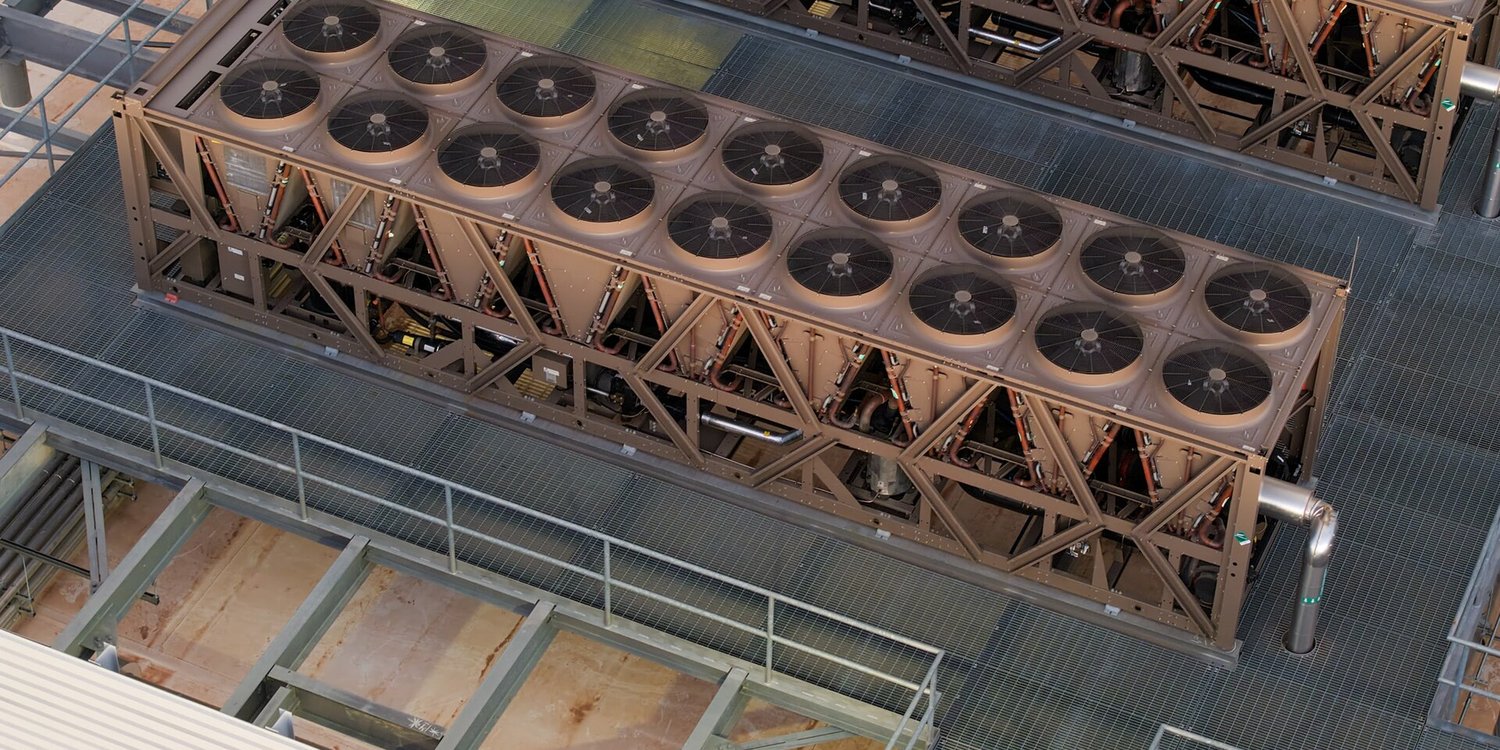
Cooling towers use water evaporation to reject heat, so the water leaves as vapor and doesn’t return to the river or the pipe. Other designs avoid that, at a cost somewhere else.
Microsoft says about 90% of its 2025 owned fleet uses low-water or zero-water cooling, and an AI design it introduced in 2024 consumes none for cooling in operation. Its direct air design, adopted in 2008, uses up to 90% less water than traditional water-based cooling by using water only when outside temperatures pass 85°F.
Google makes the other side of the trade. It says water is the most efficient means of cooling in many places, and air cooling means more electricity. Zero-water cooling removes the direct water and leaves the power plant water in place.
Amazon expects its in-row heat exchanger for AI racks to deliver a 9% reduction in water use against evaporative air-cooled data centers once fully operational.
Why company water use effectiveness numbers don’t line up
Water use effectiveness, or WUE, is liters of water per kilowatt-hour of IT load. Each company defines the water differently.
| Company | Water counted | Period | WUE (liters per kWh) |
|---|---|---|---|
| Consumption, on site | 2024 | 1.15 | |
| Microsoft | Basis not stated | 2025 | 0.27 |
| Meta | Basis not stated | 2024 | 0.19 |
| Amazon | Withdrawal | 2025 | 0.12 |
Source: Google, Microsoft, Meta and Amazon.
Google’s figure counts water that evaporates and Amazon’s counts water drawn in, so the ranking isn’t a ranking.
Where these numbers come from
Each source keeps its own units, and we didn’t convert between liters, gallons and megaliters. We calculated three figures. They are the daily gallons from LBNL’s yearly direct total, the gap between Mistral’s and Google’s per-prompt estimates, and the combined LBNL total of direct and indirect water.
The cooling and power questions for a campus in your town
LBNL expects hyperscale data centers to consume 60 to 124 billion liters directly in 2028, against 66 billion for all data centers in 2023. How a new campus cools and where its power comes from decide where it lands in that range.
Ask the developer for the cooling design and the site-level withdrawal. Meta and Microsoft already publish the second for many of their sites, so a request for it has a precedent.