One AI chatbot prompt uses about 0.24 watt-hours of electricity by Google’s 2025 measurement and 0.34 watt-hours by OpenAI’s 2025 figure, while the world’s data centers used 415 terawatt-hours in 2024, about 1.5% of global electricity. A single prompt barely registers on a household bill, but the IEA expects the data centers that run AI and everything else online to more than double their use, to about 945 terawatt-hours by 2030. The figures come from company papers, government agencies and research labs.
Top AI energy statistics
- Google says the median Gemini Apps text prompt uses 0.24 watt-hours and 0.26 milliliters of water, a measurement it published in August 2025.
- Sam Altman wrote in 2025 that the average ChatGPT query uses about 0.34 watt-hours.
- Epoch AI estimated in February 2025 that a typical GPT-4o query uses roughly 0.3 watt-hours, about a tenth of an older estimate.
- Researchers estimated that training GPT-3 took 1,287 megawatt-hours in 2020.
- US data centers used 176 terawatt-hours in 2023, 4.4% of US electricity, according to Lawrence Berkeley National Laboratory (LBNL).
- The IEA’s Base Case has global data-center use reaching around 945 terawatt-hours in 2030, up from about 415 in 2024.
- EPRI projects US data centers will use 4.6% to 9.1% of US electricity generation by 2030.
- Goldman Sachs Research forecasts global data-center power demand will rise as much as 165% by 2030 from its 2023 level.
How much energy does one AI prompt use?
Google measured 0.24 watt-hours for the median Gemini Apps text prompt in 2025, along with 0.26 milliliters of water, about five drops.
| Source | Model | Year | How it was reached | Energy per prompt (Wh) |
|---|---|---|---|---|
| Gemini Apps, median text prompt | 2025 | Measured across Google’s serving fleet | 0.24 | |
| OpenAI (Sam Altman) | ChatGPT, average query | 2025 | No method given | 0.34 |
| Epoch AI | GPT-4o, typical query | 2025 | Modeled from model size, tokens and H100 power | 0.3 |
| Jegham et al. | GPT-4o, short prompt | 2025 | Modeled from public benchmarks and hardware | 0.423 |
| Jegham et al. | GPT-4o, long prompt | 2025 | Same model, longer prompt | 2.875 |
| MIT Technology Review | Llama 3.1 405B, average response | 2025 | Measured GPU energy plus estimated overhead | 1.86 |
| EPRI | ChatGPT | 2024 | Analyst estimates cited by EPRI | 2.9 |
| Luccioni et al. | Text-generation models, mean | 2023 | Measured GPU energy over 1,000 inferences | 0.047 |
Source: Google, paper on Gemini prompt impact. OpenAI CEO Sam Altman, The Gentle Singularity. Epoch AI, How much energy does ChatGPT use?. Jegham et al.. MIT Technology Review. EPRI, Powering Intelligence. Luccioni et al., Power Hungry Processing. The Llama row converts MIT’s 6,706 joules per response to watt-hours, and the Luccioni row converts 0.047 kilowatt-hours per 1,000 inferences.
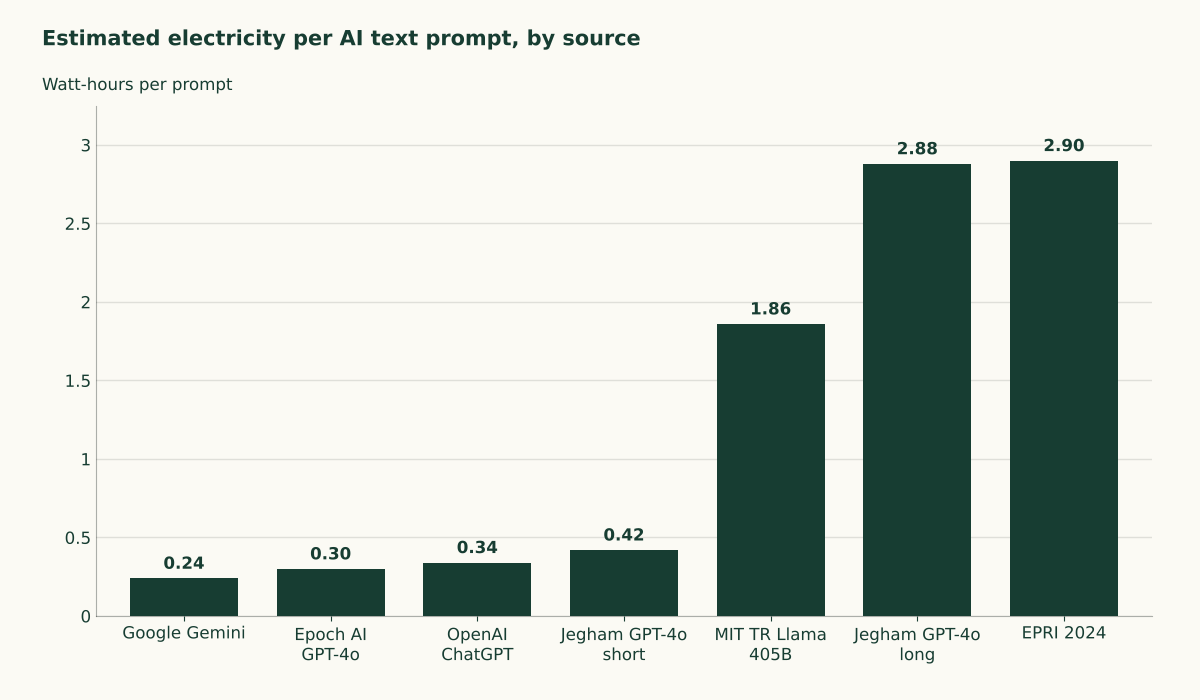
The two company figures land close together, and so does Epoch’s independent model. Together they put a typical text prompt near a third of a watt-hour, though each figure rests on its own assumptions and none covers image, video or long reasoning requests.
Jegham and colleagues found that long prompts on the most energy-intensive models exceed 29 watt-hours, more than 65 times the most efficient systems they tested.
Image generation costs more per request than text. Luccioni and colleagues measured up to 2.9 kilowatt-hours per 1,000 inferences for image models in 2023, against 0.047 for text generation.
Why do the per-prompt estimates disagree?
Estimates diverge on what gets counted, which average is reported, how long the prompt is and which year’s hardware ran it.
What gets counted changes the final number. Google’s measurement includes the accelerators, the host machine, idle capacity and data center overhead, so it covers the whole serving stack. MIT’s figure starts with GPU energy and then adds an estimate for cooling and other demands. Altman’s sentence doesn’t say what it counts.
The average matters too. Google reports a median, which sits in the middle of all prompts, while OpenAI says “average.” A few long prompts pull a mean above a median.
Prompt length and model size change the answer inside a single table. In the table above, the same model takes several times more energy on a long prompt than on a short one. MIT’s smaller Llama model needed 114 joules per response, against 6,706 joules for the 405-billion-parameter one.
Year is the last. Epoch traced the old 3 watt-hour figure to Alex de Vries in 2023, who assumed more tokens per query and older chips. EPRI’s 2.9 watt-hours rests on the same generation of analyst estimates. Google reports its own median prompt got 33 times more energy efficient in one year, so an estimate built on 2023 hardware will run high against a 2025 measurement.
Does an AI prompt use more electricity than a Google search?
A short chatbot query uses more than a search. A May 2025 study compared a 0.42 watt-hour GPT-4o query with a Google search at 0.30 and found the chatbot prompt about 40% higher. The search figure comes from the same paper and predates Google’s own 2025 Gemini measurement, so treat the comparison as rough.
Reasoning models widen the gap. In the same study, OpenAI’s o3 model used 12.222 watt-hours on a long prompt, against 2.875 for GPT-4o. If you switch a chatbot to a reasoning mode for everyday questions, you’re choosing the expensive end of that range.
How does one prompt compare with your home’s electricity?
An average US home used 10,359 kilowatt-hours of electricity in 2024, the equivalent of about 43 million median Gemini prompts, so a single prompt barely registers on your bill.
Heavy chat use doesn’t change the picture. The same researchers put the average ChatGPT user at about eight queries a day in April 2025. At OpenAI’s average per-query figure, a year of that adds up to roughly one kilowatt-hour, less than a thousandth of what your home buys. For the household side of that arithmetic, see how much electricity a house uses.
The total is where the grid feels it, and the AI strain on aging wires is the longer story behind the numbers that follow.
How much energy does it take to train an AI model?
Training is a one-time cost per model, and only a few makers have published it. The documented examples are a few years old, and none of the sources checked gives a training energy figure for the newest OpenAI or Google models.
| Model | Year | GPU hours (millions) | Electricity (MWh) | How the figure was reached |
|---|---|---|---|---|
| GPT-3 | 2020 | n/a | 1,287 | Outside estimate from 10,000 V100 GPUs |
| BLOOM (176B) | 2022 | n/a | 433.2 | Measured for the final training run |
| Llama 2 70B | 2023 | 1.72 | 688 | GPU hours times 400 W rated power |
| Llama 3.1 405B | 2024 | 30.84 | 21,590 | GPU hours times 700 W rated power |
Source: Patterson et al. (2021). Luccioni et al. on BLOOM. Meta, Llama 2 70B model card. Meta, Llama 3.1 405B model card. The two Llama electricity figures multiply Meta’s GPU hours by its power ratings, so they are upper bounds for the GPUs alone.
The two Llama rows are ceilings, and the later model used far more GPU hours than the earlier one. Meta reports GPU hours and a per-GPU power rating but no megawatt-hours, and real GPUs draw less than their rating while cooling and servers add overhead. Meta does report that training the 405B model emitted 8,930 tonnes of CO2 equivalent on a location basis.
Mistral AI’s lifecycle analysis, published in 2025, found that training Mistral Large 2 and running it for 18 months emitted 20.4 kilotonnes of CO2 equivalent. The same period used 281,000 cubic meters of water.
How much electricity do data centers use in total?
Data centers worldwide used 415 terawatt-hours in 2024, roughly 1.5% of the world’s electricity, according to the IEA’s Energy and AI report. That covers every workload, from email and storage to AI, so it’s an upper bound on what AI alone uses.
In the US, DOE says data centers climbed from 58 terawatt-hours in 2014 to 176 in 2023, about three times the 2014 level.
| Year | US data center use (TWh) | Share of US electricity (%) |
|---|---|---|
| 2014 | 58 | n/a |
| 2018 | 76 | 1.9 |
| 2023 | 176 | 4.4 |
| 2028, low case | 325 | 6.7 |
| 2028, high case | 580 | 12 |
Source: DOE, report on data center electricity demand. Lawrence Berkeley National Laboratory, 2024 United States Data Center Energy Usage Report. The 2028 rows are LBNL scenarios.
How much of that electricity goes to AI?
No source checked gives AI alone as a share of world electricity, but two give pieces. Goldman Sachs Research put AI at 14% of global data-center power capacity in its February 2025 report and expects 27% by 2027. Capacity measures power at one moment, so it isn’t a share of yearly energy.
For the US, MIT Technology Review reports LBNL’s projection that more than half of data center electricity would go to AI by 2028, which it puts at 165 to 326 terawatt-hours a year.
How do forecasts for AI and data center energy compare?
The six forecasts below come from an agency, two research groups, a bank, a data provider and an academic.
| Forecaster | Scope | Target year | Forecast |
|---|---|---|---|
| IEA, Base Case | Global data centers | 2030 | About 945 TWh, about 3% of global electricity |
| LBNL and DOE | US data centers | 2028 | 325 to 580 TWh, 6.7% to 12% of US electricity |
| EPRI | US data centers | 2030 | 4.6% to 9.1% of US generation |
| Goldman Sachs Research | Global data centers | 2030 | Up to 165% above 2023 |
| BloombergNEF | US data centers | 2035 | 8.6% of US electricity, 78 GW |
| de Vries (Joule, 2023) | AI servers only, global | 2027 | 85 to 134 TWh more per year |
Source: IEA (East Asia report). DOE. EPRI, Powering Intelligence. Goldman Sachs Research. BloombergNEF. Cell Press release on de Vries’s Joule paper.
EPRI built four growth scenarios, and they span 4.6% to 9.1% of US generation in 2030.
The IEA’s 945 terawatt-hours would be about 2.3 times the 2024 level and roughly Japan’s yearly electricity use. Every forecast in the table points up, but they disagree on how far, because each counts a different place, year and set of machines.
How we compiled these numbers
We took per-prompt figures from company disclosures, outside estimates and measurements of open models, and the table says which is which. A few numbers are our arithmetic on sourced inputs. They convert joules to watt-hours, multiply GPU hours by rated power and divide terawatt-hours by home use. The forecasts count different things, so we haven’t added them together or averaged them.
What 176 to 580 terawatt-hours would mean for your grid
At 10,359 kilowatt-hours per home a year, the 176 terawatt-hours US data centers used in 2023 equal the electricity of about 17 million homes. LBNL’s 2028 range would be nearly double to more than triple that.
Supplying that much depends on new power plants, which grid operators such as PJM line up years in advance through capacity auctions, and on how much wind and solar the grid can absorb. What it costs households shows up in electricity prices by state.