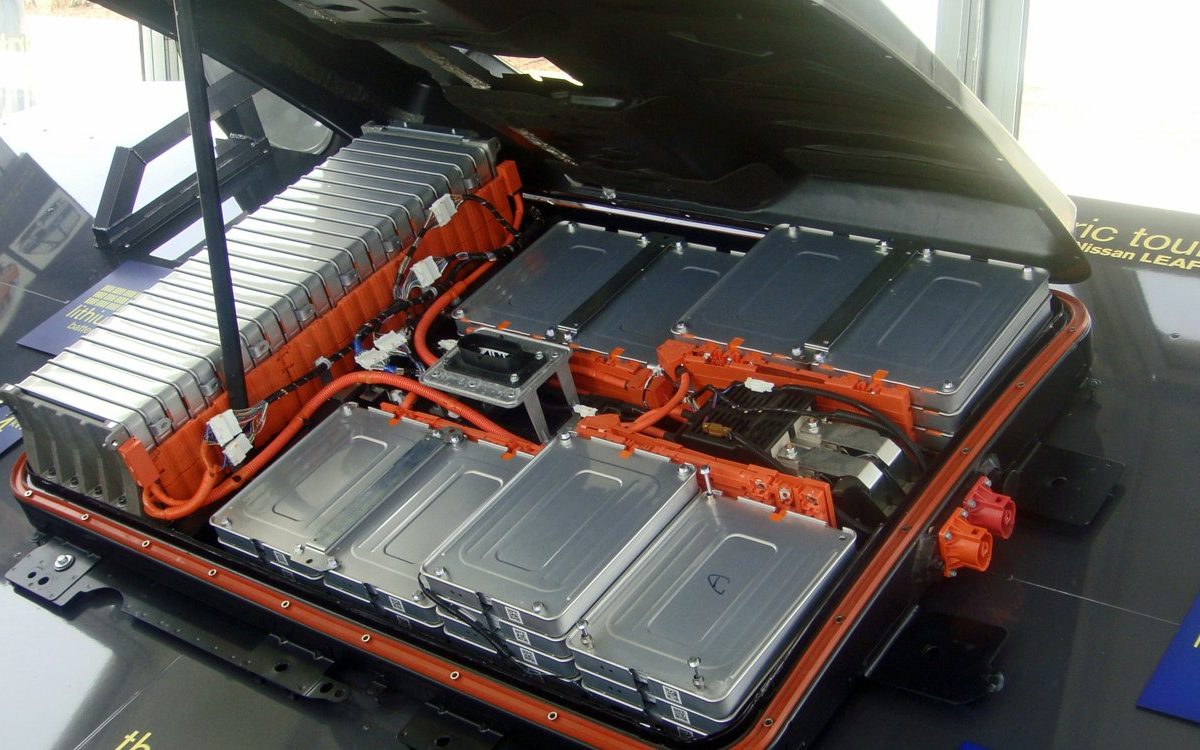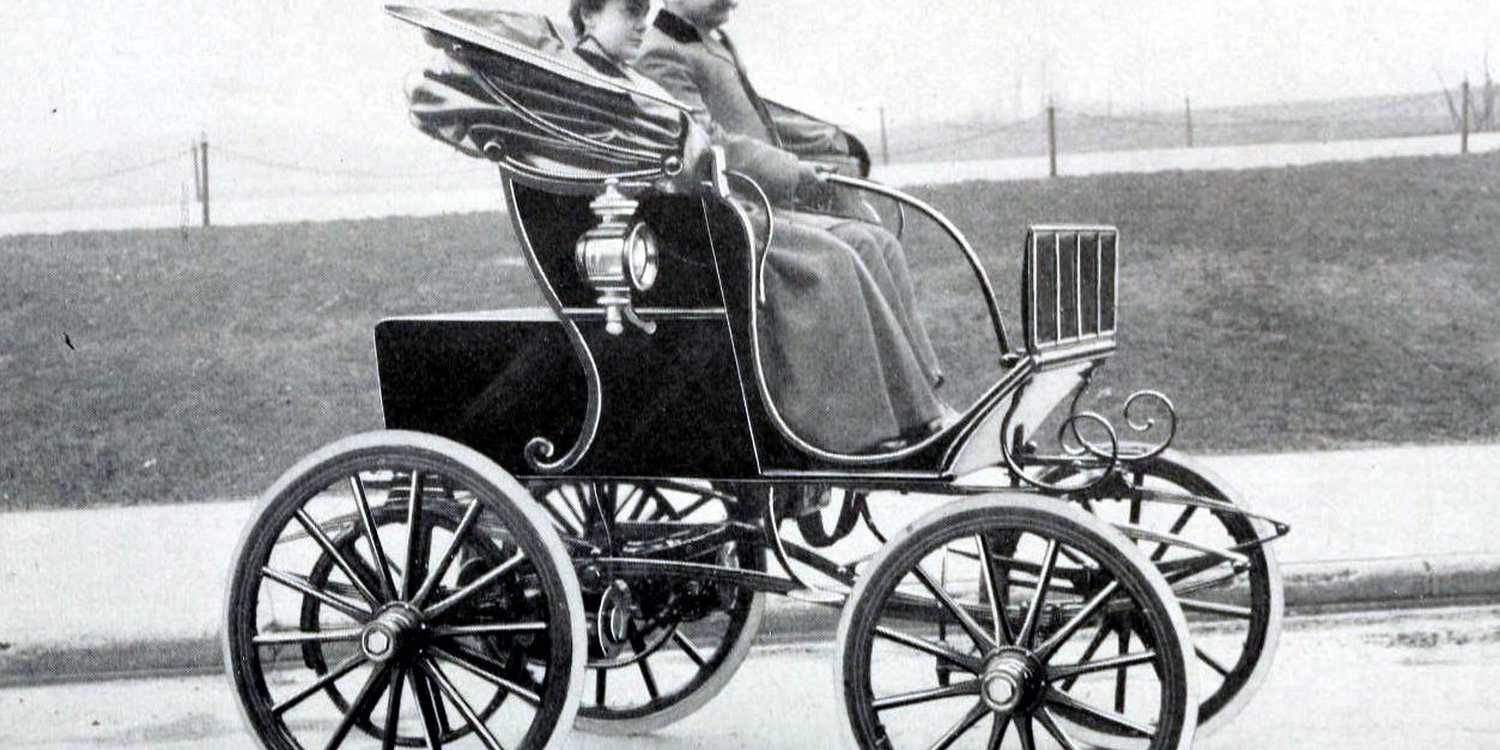
The first electric car is hard to pinpoint to one inventor or country, says the Department of Energy, but a Groningen museum backs a small cart from 1835 as the earliest, and William Morrison’s 1890 carriage, which cruised at 14 mph, was the first successful American one. Which one counts depends on whether you mean a working model or a car a person could use day to day. It took until 2023 for US plug-in sales to pass 1 million in a single year.
First electric car statistics
- The University of Groningen’s museum calls Sibrandus Stratingh’s 3 kg cart, a design from 1835, the first electric car in the world.
- Electric vehicles were 37.6% of the 4,192 motor vehicles built in the US in 1900, a share computed from the Census Bureau’s counts.
- Detroit Electric built 13,000 electric cars between 1907 and 1939, most of them before the 1929 stock market crash.
- The US had 8,000 registered automobiles in 1900 and 17,481,001 in 1925, counting every power type.
- Tesla’s own filing reported a 236 mile range for the Roadster, which it began delivering in early 2008.
- The 2011 Nissan Leaf had an EPA range of 73 miles and a $32,780 list price.
- US plug-in sales grew from 17,763 in 2011 to 1,402,371 in 2023.
- Argonne counted about 1.5 million plug-in vehicles sold in 2025, 4% below 2024.
- The IEA counted more than 20 million electric car sales worldwide in 2025.
Who made the first electric car?
According to the University of Groningen’s museum, Sibrandus Stratingh built the first electric vehicle that could carry a load, a small cart made in 1835.
The cart the museum shows is an improved version of that original, and it weighs 3 kg, runs for 20 minutes on a full battery and carries 1.5 kg. Stratingh bent the straight magnets in Moritz von Jacobi’s motor design, which the museum says let the motor generate twice as much energy.
| Year | Builder | Place | Vehicle | Specs | Status |
|---|---|---|---|---|---|
| 1832 | Robert Anderson | Scotland | Electric carriage | One-charge battery | One source here |
| 1834 | Thomas Davenport | Vermont, US | Electric motor and model train | n/a | Motor, not a car |
| 1835 | Sibrandus Stratingh | Groningen, Netherlands | Electric cart | 3 kg, carries 1.5 kg | Museum calls it first |
| 1842 | Robert Davidson | Scotland | Galvani locomotive | 4 mph | Locomotive, not a car |
| 1881 | Gustave Trouvé | Paris | Electric tricycle | Lead-acid batteries, Siemens motor | Guinness record holder |
| 1884 | Thomas Parker | Wolverhampton, England | Electric car | n/a | Called first practical |
| 1890 | William Morrison | Des Moines, US | Electric carriage | 14 mph, 50 mile range | First successful in US |
| 1899 | Camille Jenatzy | Belgian driver | La Jamais Contente | 65.8 mph | Speed record car |
| 1900 | Lohner-Porsche | Vienna and Paris | Hub-motor car | 32 km/h | Premiered April 14 |
Source: Museum.nl, Stratingh’s cart, HISTORY, Engineering and Technology History Wiki, Vermont Public, Gazetteer for Scotland, Guinness World Records, Institution of Engineering and Technology, State Historical Society of Iowa, Porsche Newsroom. The Anderson row rests on HISTORY alone.
Other sources name other firsts. HISTORY credits Robert Anderson of Scotland with the first horseless carriage powered by an electric motor, built in 1832. It quotes the author Kevin A. Wilson saying the machine qualifies as a vehicle, though it can be argued that it isn’t a car.
Among this page’s sources, HISTORY alone names Anderson, so treat his carriage as single-sourced.
Two other early names built machines that weren’t cars. Thomas Davenport of Vermont built an electric motor in 1834 and a model electric train, and Robert Davidson’s Galvani locomotive ran at 4 mph on the Edinburgh and Glasgow Railway in 1842 before being dismissed as insufficiently powerful.
A working model and a locomotive are different machines from a car with a seat for a rider, and only the car looks like the electric vehicles on sale in 2026.
The State Historical Society of Iowa says William Morrison’s 1890 carriage in Des Moines carried up to 12 passengers at 14 mph and needed a recharge after 50 miles. The Energy Department’s history gives six passengers. Neither page says how it counted.
When did electric cars become practical?
Electric cars needed a battery that could be recharged, and in 1859 Gaston Planté designed a lead-acid battery that could store a useful amount of energy.
Gustave Trouvé fitted a pedal tricycle with lead-acid batteries and a Siemens motor and ran it down a Paris street in April 1881, which Guinness World Records lists as the first electric road vehicle. In England, an IET presentation says Thomas Parker built the first practical production electric car in 1884, while Grace’s Guide says only that he developed his first electric car that year.
The sources don’t agree on which car was the earliest practical one. The IET names Parker, and the Iowa historical society names Morrison for the US.
On April 14, 1900, the Lohner-Porsche electric car premiered at the Paris Exposition with a hub motor in each front wheel and a top speed of 32 km/h.
How many cars were electric in 1900?
Steam led US motor vehicle production in 1900 and electric came second, with the Census Bureau counting 1,575 electric vehicles among 4,192 built.
| Source | Basis | Electric (%) | Steam (%) | Gasoline (%) |
|---|---|---|---|---|
| US Census Bureau | Vehicles built, by count | 37.6 | 40.1 | 22.3 |
| US Census Bureau | Vehicles built, by value | 58.6 | 23.4 | 17.9 |
| Electrek | Labeled “on the road” | 38 | 40 | 22 |
| HISTORY | Cars on a 1900 show floor | about 33 | n/a | n/a |
Source: US Census Bureau, Twelfth Census, Volume X, Table 7, shares computed from its counts and reported values. Electrek. HISTORY, a third of 160 cars at New York’s first car show in November 1900.
The shares differ because the sources count different things. The Census counted vehicles built and the value manufacturers reported for them, and HISTORY counted cars on a show floor.
Electrek calls that 38% split a share of vehicles “on the road,” but the Census counted vehicles built in a single year.
We computed the Census shares by dividing each vehicle type’s count, and its reported value, by the year’s total. HISTORY alone backs the Anderson row, and we found no federal or museum count of how many early electric cars were on the road.
Who bought electric cars in the early 1900s?
Before World War I, many women chose electric cars because they started instantly without hand cranking, according to The Henry Ford. At the 1914 average wage, you’d have worked about five years and 11 months to buy a Detroit Electric Model 47, which cost $3,730 as outfitted, by the museum’s own math.
The Smithsonian’s record for a 1904 Columbia says electric cars were expensive and electricity rates were high, and that maintaining batteries was a complicated, hazardous task.
Makers stayed small. Baker Electric of Cleveland was building about 400 cars a year by 1905, and Riker’s Electric Vehicle Company, founded in 1899, built more than a dozen types of electric cars and trucks.
Why did gasoline cars win?
A Ford Model T runabout cost $825 in 1909 and $260 by 1925, which IEEE Spectrum says came to about two and a half months of wages for the average worker.
| Year | Vehicle | Price ($) |
|---|---|---|
| 1909 | Ford Model T runabout | 825 |
| 1912 | Gasoline car | 650 |
| 1912 | Electric roadster | 1,750 |
| 1914 | Detroit Electric Model 47, as outfitted | 3,730 |
| 1925 | Ford Model T runabout | 260 |
Source: IEEE Spectrum, US Department of Energy, The Henry Ford. Prices are nominal dollars for different vehicle classes, so read each row on its own.
Starting a gasoline engine meant turning a hand crank, which kept some people, especially women, from operating cars. Cadillac introduced the self-starter in its 1912 model, and Henry Ford began offering one on the Model T in 1919.
The IEEE History Center says Ford’s cheap mass production and design improvements, especially the self-starter, contributed to gasoline’s dominance from the 1910s. In Texas, the Spindletop gusher of January 10, 1901 marked the birth of the modern petroleum industry, and its wells yielded 17,500,000 barrels in 1902.
How many cars were on US roads by the 1920s?
US registered automobiles went from 8,000 in 1900 to 15,436,102 in 1924, counting every power type.
| Year | Registered cars |
|---|---|
| 1900 | 8,000 |
| 1902 | 23,000 |
| 1904 | 54,590 |
| 1906 | 105,900 |
| 1908 | 194,400 |
| 1910 | 458,377 |
| 1912 | 901,596 |
| 1914 | 1,664,003 |
| 1916 | 3,367,889 |
| 1918 | 5,554,952 |
| 1920 | 8,131,522 |
| 1922 | 10,704,076 |
| 1924 | 15,436,102 |
Source: Federal Highway Administration, Highway Statistics Summary to 1995, Table MV-200. Every second year from 1900 to 1924.
The table doesn’t split registrations by power type, so it can’t say how many of those cars were electric.
What was the GM EV1?
GM announced the EV1 on January 4, 1996, and at its debut it was lease-only in two states, Arizona and California. If you lived outside those two states, you couldn’t lease one at launch.
The EV1 began in the 1990s as a response to a zero-emission vehicle mandate from California’s Air Resources Board.
Production counts differ. HISTORY says around 2,500 EV1s were produced from 1996 to 1999, while the Smithsonian says GM built 1,117 and canceled the program in 2003. The counts can’t both be right, and the Smithsonian’s is the exact one.
Which electric cars came after the EV1?
Tesla began delivering the Roadster in early 2008 and had sold 937 of them in 18 countries by December 31, 2009.
If you bought a 2011 Nissan Leaf, you paid a list price of $32,780 before incentives for a car the EPA rated at 73 miles. It went on sale in December 2010 in 5 states.
The Chevrolet Volt, a plug-in hybrid, was rated at 35 miles on electricity and 380 miles in total. The 2013 Tesla Model S with the 60 kWh pack was rated at 208 miles. The version with the 85 kWh pack was rated at 265 miles.
| Year | Model | Type | Electric range (mi) | MSRP ($) |
|---|---|---|---|---|
| 2008 | Tesla Roadster | Battery electric | 236 | n/a |
| 2011 | Nissan Leaf | Battery electric | 73 | 32,780 |
| 2011 | Chevrolet Volt | Plug-in hybrid | 35 | 41,000 |
| 2013 | Tesla Model S, 60 kWh | Battery electric | 208 | 69,900 |
| 2013 | Tesla Model S, 85 kWh | Battery electric | 265 | 94,900 |
Source: Tesla Form S-1, where Tesla reports the Roadster’s range, fueleconomy.gov, Nissan Leaf, Chevrolet Volt, Model S 60 kWh and Model S 85 kWh. Years are model years except the Roadster’s first deliveries.
How many plug-in cars has the US sold each year?
Plug-in vehicles sold in the US since 2010 reached 4.7 million in 2023, after mass-market sales began at the end of 2010.
| Year | Battery electric (thousands) | Plug-in hybrid (thousands) | Total (thousands) |
|---|---|---|---|
| 2011 | 10.092 | 7.671 | 17.763 |
| 2012 | 14.587 | 38.584 | 53.171 |
| 2013 | 48.094 | 49.008 | 97.102 |
| 2014 | 63.525 | 55.357 | 118.882 |
| 2015 | 71.064 | 43.008 | 114.072 |
| 2016 | 86.731 | 72.885 | 159.616 |
| 2017 | 104.487 | 91.188 | 195.675 |
| 2018 | 207.062 | 123.883 | 330.945 |
| 2019 | 233.822 | 85.791 | 319.613 |
| 2020 | 238.540 | 69.049 | 307.589 |
| 2021 | 459.474 | 176.117 | 635.591 |
| 2022 | 747.982 | 183.411 | 931.393 |
| 2023 | 1,109.313 | 293.058 | 1,402.371 |
Source: US Department of Energy, Fact of the Week 1327 data file, from Argonne National Laboratory, as published January 29, 2024. Thousands of new light-duty battery electric and plug-in hybrid vehicles by calendar year.
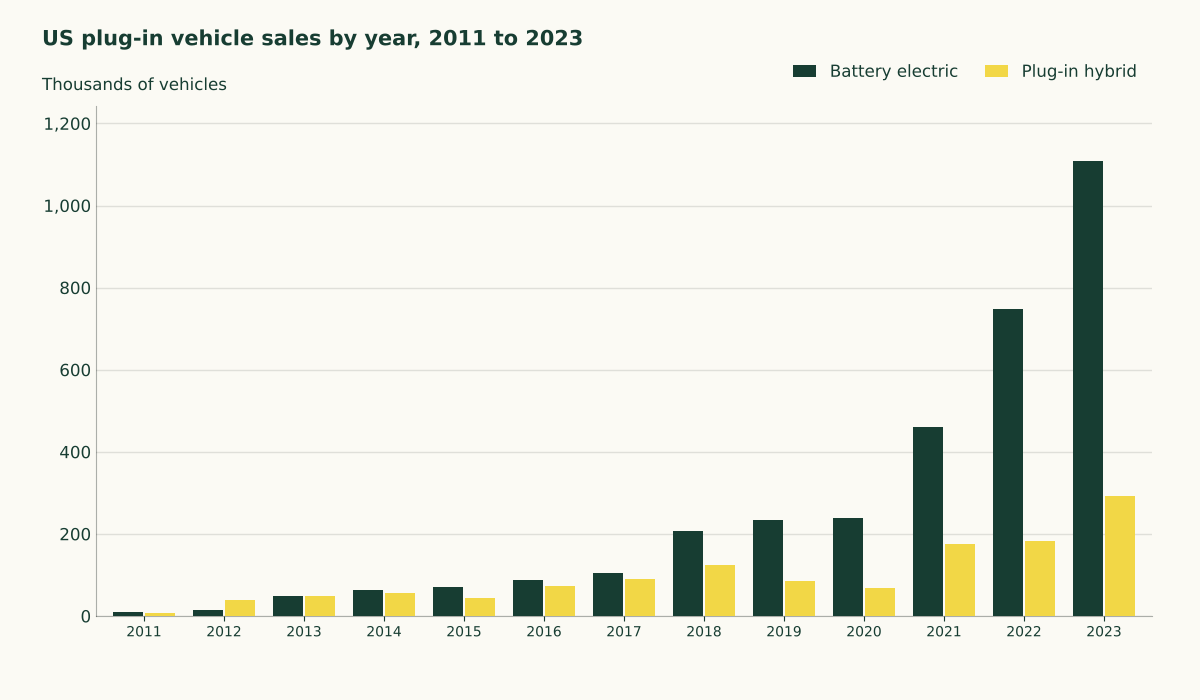
Cumulative sales passed 1 million by October 2018. Annual totals slipped two years running, 2019 and 2020, then more than doubled the next year.
Argonne’s count of about 1.5 million plug-in vehicles for 2025 ran 4% below 2024. EIA calls 2025 the first year battery electric sales and share declined.
Two federal tax credits for new electric vehicles expired on September 30, 2025, the month battery electric cars hit a record 12% share before dropping below 6% in each remaining month of 2025.
The DOE and DOT Joint Office put plug-ins at 9.4% of US passenger vehicle sales in 2023, up from 6.8% in 2022. The sales story gets its own page on new electric vehicle adoption.
These counts cover battery electric and plug-in hybrid cars, so natural gas cars and hydrogen fuel cell vehicles sit outside them.
How far has the electric car come since Stratingh’s cart?
Electric vehicles were 2% of all registered light-duty vehicles in the US in 2024, according to EIA.
Battery electric cars were 6% of new vehicle sales in the first six months of 2026, down from 7% in the same months of 2025. That count covers battery electric cars alone, so it doesn’t compare with the plug-in share DOE reported for 2023.
Worldwide, the IEA counted more than 20 million electric car sales in 2025 after more than 17 million in 2024, and its Global EV Outlook 2026 forecasts 23 million for 2026.
If you’re thinking about buying one, the page on what charging an electric car costs gives the cost of charging at home for specific models, with electricity prices by state.