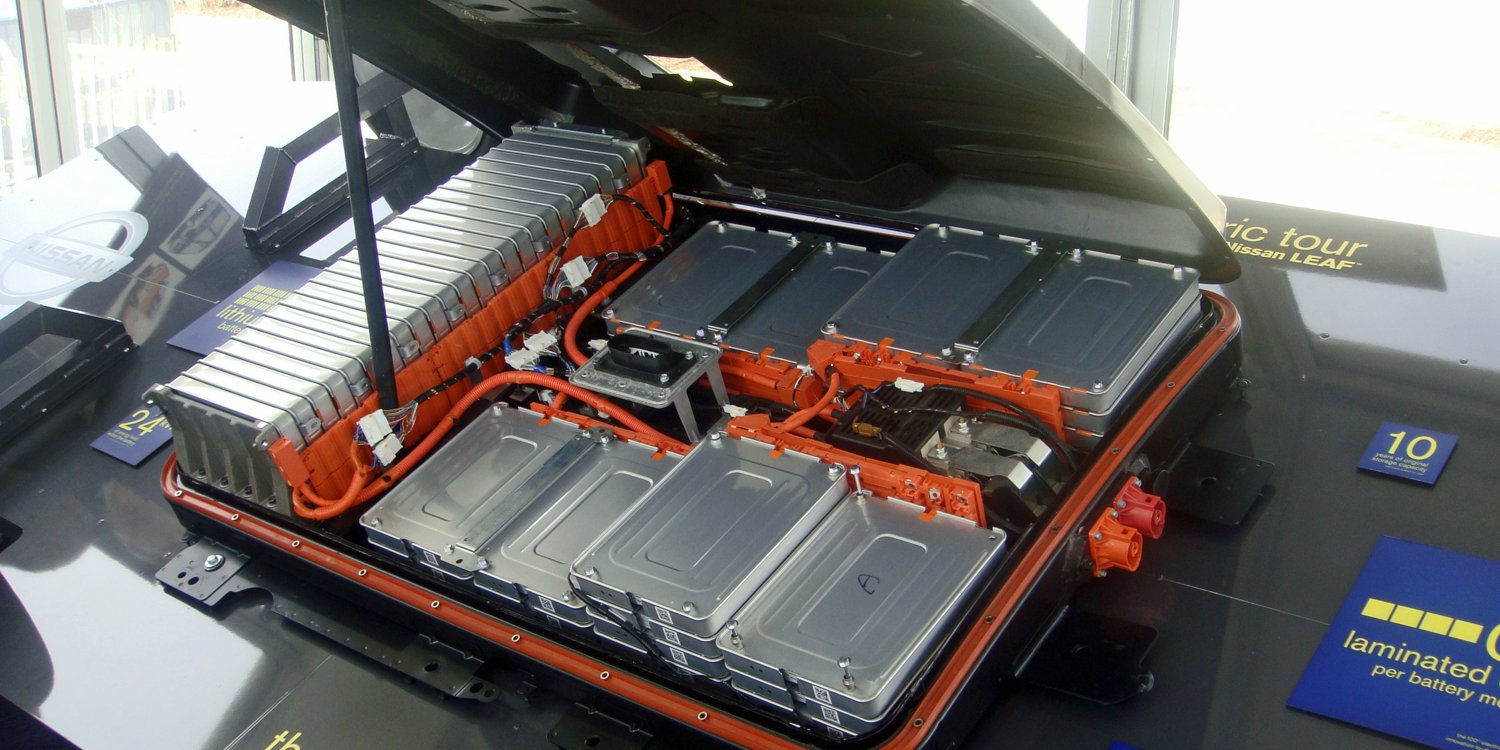
An EV battery is a pack of lithium-ion cells that stores the electricity an electric car drives on, and packs cost an average of $108 per kilowatt-hour in 2025, 8% less than in 2024, BloombergNEF found. The Department of Energy (DOE) says most plug-in hybrids and all-electric vehicles use lithium-ion batteries, and Recurrent puts a replacement outside warranty at $5,000 to $16,000.
Top EV battery statistics
- DOE estimates a light-duty EV battery pack cost $139 per kWh in 2023, 90% less than in 2008, in 2023 dollars.
- The average new US battery-electric car had 292 miles of EPA range in model year 2024, almost four times the 2011 average.
- Recurrent’s November 2025 study of more than 30,000 EVs found that 0.3% of models from 2022 onward had a battery replaced.
- Many carmakers offer 8-year/100,000-mile battery warranties, according to DOE.
- China made over 80% of the world’s battery cells in 2025, the IEA reports.
- World lithium output from mines rose 31% to about 290,000 tons in 2025, USGS estimates.
- CATL supplied 39.4% of the EV batteries installed worldwide from January to August 2026, according to SNE Research data.
- Redwood Materials says it recovers more than 95% of the lithium, nickel, cobalt and copper in the products it processes.
What does an EV battery cost per kilowatt-hour?
DOE estimates a light-duty EV pack cost $139 per kilowatt-hour in 2023 when built in a factory making at least 100,000 packs a year. That figure counts the usable energy, the part of the pack a driver can draw on.
BloombergNEF’s survey measures pack prices across cars and stationary storage worldwide. It found packs cost $84 per kWh in China in 2025, with North America 44% higher, which works out to about $121 per kilowatt-hour for a North American pack.
At that price, the 85 kWh pack in a Chevrolet Equinox EV is worth about $10,300 before labor. Multiply any car’s pack size by the price per kilowatt-hour and you have a rough value for the pack alone.
The battery is one part of electric vehicle technology, alongside motors and charging. If you’re weighing a fuel cell car instead, the hydrogen fuel cells page covers that drivetrain.
How much has the price of an EV battery fallen?
DOE estimates that EV pack cost fell 90% between 2008 and 2023, from $1,415 to $139 per kWh, in 2023 dollars.
| Year | Pack cost in 2023 dollars ($/kWh) | Pack cost in current dollars ($/kWh) |
|---|---|---|
| 2008 | 1,415 | 1,000 |
| 2009 | 1,324 | 933 |
| 2010 | 1,053 | 753 |
| 2011 | 785 | 580 |
| 2012 | 589 | 444 |
| 2013 | 424 | 324 |
| 2014 | 372 | 289 |
| 2015 | 340 | 264 |
| 2016 | 311 | 245 |
| 2017 | 272 | 219 |
| 2018 | 239 | 197 |
| 2019 | 220 | 185 |
| 2020 | 199 | 169 |
| 2021 | 177 | 157 |
| 2022 | 159 | 153 |
| 2023 | 139 | 139 |
Source: DOE Vehicle Technologies Office, Fact of the Week #1354 dataset, built on Argonne National Laboratory’s BatPaC model. Costs are for usable energy at 100,000 or more packs a year.
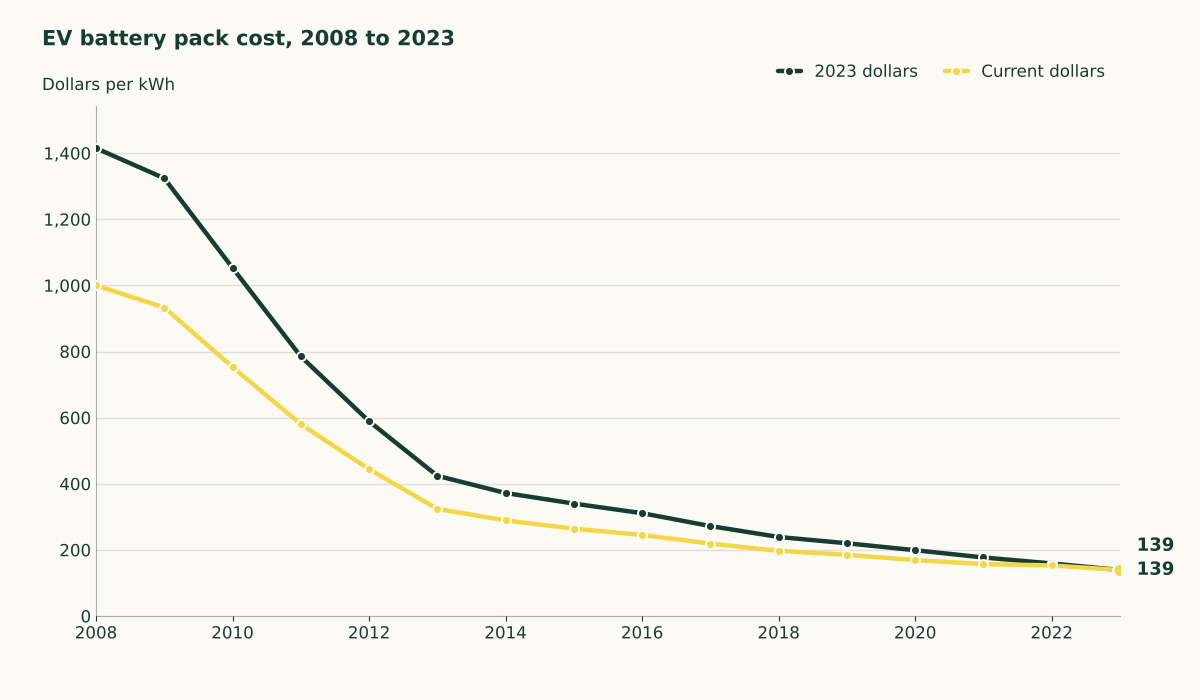
Most of the fall came early. The cost in 2023 dollars dropped 70% from 2008 to 2013, to $424, and the next ten years took it down to $139.
BloombergNEF’s survey found a 20% drop to $115 per kWh in 2024, and it names cell manufacturing overcapacity and cheaper LFP batteries among the factors. Cell makers had 3.1 TWh of commissioned capacity that year, more than 2.5 times demand.
We didn’t join the two series. DOE’s figures are modeled costs for usable energy, and BloombergNEF’s are surveyed market prices. The per-kilowatt-hour and pack-value estimates in the section above are our arithmetic on BloombergNEF’s China price and North American premium.
Which chemistries do EV batteries use?
Lithium iron phosphate (LFP) batteries made up over 55% of EV batteries deployed worldwide in 2025, up from nearly 50% in 2024, the IEA reports.
The IEA also says LFP packs were more than 40% cheaper on average than nickel manganese cobalt (NMC) packs. BloombergNEF’s averages, in the table below, put the gap at a little over a third, so the two sources agree on direction and differ on size.
| Chemistry | Pack price in 2025 ($/kWh) | Latest cells, up to (Wh/kg) | Where it stands |
|---|---|---|---|
| LFP (lithium iron phosphate) | 81 | 205 | Over 55% of 2025 EV batteries worldwide |
| NMC (nickel manganese cobalt) | 128 | 265 | Almost 80% of non-China EV batteries use nickel-based cells |
| Sodium-ion | n/a | 175 | Just over 1% of lithium-ion cell capacity |
| LMR (lithium manganese-rich) | n/a | n/a | GM cells planned for 2028 |
| Solid-state | n/a | n/a | Toyota’s first car planned by 2028, premium models only to the early 2030s |
Source: BloombergNEF, 2025 lithium-ion battery price survey (average across all segments), IEA, Global EV Outlook 2026 and General Motors, LMR announcement.
Which chemistry is in your car depends on the model. Chevrolet’s 2027 Bolt uses LFP cells in a 65 kWh pack.
How big is an EV battery, and how far does it go?
The average new US battery-electric car had 292 miles of EPA range in model year 2024, almost four times the 2011 average. Pack size sets much of that range, as the five models below show.
| Model | Pack size (kWh) | EPA range (miles) | EPA efficiency (kWh per 100 miles) |
|---|---|---|---|
| Hyundai Ioniq 5 Standard Range (2026) | 63 | 245 | 29 |
| Chevrolet Bolt (2027) | 65 | 262 | 28 |
| Nissan Leaf 75 kWh (2026) | 75 | 303 | 28 |
| Hyundai Ioniq 5 RWD (2026) | 84 | 318 | 30 |
| Chevrolet Equinox EV FWD (2026) | 85 | 319 | 31 |
Source: Pack sizes from Hyundai, Chevrolet, Nissan and Chevrolet. Range and efficiency from fueleconomy.gov for the Ioniq 5 Standard Range, Bolt, Leaf, Ioniq 5 RWD and Equinox EV.
The two smallest packs in the table are also the two shortest-range cars. Wheels move range too. The same Leaf is rated for 303 miles on steel wheels and 259 miles on 19-inch wheels.
GM calls the Bolt’s 65 kWh its rated energy, and the other sizes are each maker’s own figures, so check whether a number is rated or usable energy before you compare cars.
How long does an EV battery last?
Geotab’s 2025 analysis of 22,700 EVs found the average battery loses 2.3% of its capacity a year, which projects to 81.6% of the original capacity after eight years.
How you charge matters. Cars that often used high-power DC fast charging lost 3.0% a year, against 1.5% for low-power charging. Geotab’s 2023 analysis of 11 common models found 1.8% a year, and Geotab says the return to 2.3% doesn’t mean batteries are getting worse.
Batteries that fail outright are rare. Recurrent’s 2025 study found that 0.3% of EVs from 2022 onward had a battery replaced, against 2% of second-generation EVs and 8.5% of first-generation ones, and some of those were warranty or recall swaps.
The data is young. About 75% of EVs on the road were sold in or after 2023, Recurrent says, and it calls them too new to show meaningful degradation.
What does an EV battery warranty cover?
Many manufacturers offer 8-year/100,000-mile warranties for their EV batteries, according to DOE. AAA says most EVs carry battery warranties of 8 to 10 years or up to 100,000 miles, and that a maker will typically repair or replace a pack that falls below a set share of its original charge.
California’s Advanced Clean Cars II rule text writes similar coverage into regulation. It requires battery-electric and plug-in hybrid makers to warrant the battery against losing health below 70% for 8 years or 100,000 miles on 2026 through 2030 models. From 2031 the threshold rises to 75%.
That rule is contested. The President signed a resolution on June 12, 2025 disapproving the EPA waiver for Advanced Clean Cars II, and California led a coalition of 10 attorneys general in suing the federal government the same day. Neither source says how the suit ended.
The federal emissions warranty is a separate rule. It runs 8 years or 80,000 miles for specified major emission control components. Before you compare cars, read how many years and miles each battery warranty covers and what capacity loss triggers it.
How much does it cost to replace an EV battery?
Recurrent puts replacement outside warranty at $5,000 to $16,000, depending on pack size and maker, and calls out-of-pocket replacements rare. AAA’s range is $5,000 to $20,000 or more, and the high end comes from the flagship packs of 100 kWh and more in its table.
| Pack size | Replacement low ($) | Replacement high ($) |
|---|---|---|
| Small packs (20 to 30 kWh) | 4,000 | 9,000 |
| Mid-size packs (40 to 60 kWh) | 7,000 | 14,000 |
| Large packs (75 to 100 kWh) | 10,000 | 18,000 |
| Flagship packs (100+ kWh) | 15,000 | 25,000 |
Source: AAA, How Much Does an EV Battery Replacement Cost? Prices include parts and labor.
How and where are EV batteries made?
The IEA counts more than 20 million electric cars sold worldwide in 2025, and the electric vehicle sales page follows where they sold. China made 70% of electric cars and over 80% of battery cells in 2025, the IEA reports.
A cell starts as electrode material. In the conventional method, Argonne National Laboratory says, a slurry of active material, conductive material and binder is cast onto a metal foil and heat-dried in an oven, then pressed between rollers. Dry processing can cut manufacturing costs 11% and energy use 46%, Argonne estimates.
| Step in the supply chain | Share held by one country (%) |
|---|---|
| Cobalt mined in Congo (Kinshasa), 2025 | 73 |
| Natural graphite mined in China, 2025 | 82 |
| Battery cells made in China, 2025 (over) | 80 |
| Cathode active material made in China, 2025 (about) | 85 |
| Anode active material made in China, 2025 (over) | 90 |
Source: U.S. Geological Survey, Mineral Commodity Summaries 2026: Cobalt and Graphite, and IEA, Global EV Outlook 2026: Manufacturing and trade.
Congo leads cobalt mining, and China leads the other four steps in the table.
Australia led lithium mining in 2025, and batteries account for 88% of global lithium use, from EV packs to grid storage. The battery storage on the grid page covers the storage half.
| Country | Lithium mined in 2024 (tons) | Lithium mined in 2025 (tons) |
|---|---|---|
| Australia | 82,700 | 92,000 |
| China | 41,400 | 62,000 |
| Chile | 48,900 | 56,000 |
| Zimbabwe | 20,000 | 28,000 |
| Argentina | 13,800 | 23,000 |
| Brazil | 10,200 | 12,000 |
| Mali | 770 | 9,400 |
| Canada | 4,820 | 5,600 |
| Portugal | 380 | 380 |
Source: U.S. Geological Survey, Mineral Commodity Summaries 2026: Lithium. Lithium content. US production is withheld.
On the cell side, CATL and BYD led. SNE Research counted 844.2 GWh of EV batteries installed worldwide from January to August 2026, and CATL had 39.4% of that and BYD 15.1%. The count includes hybrids and covers eight months, so it doesn’t line up with the IEA’s full-year figures.
Can EV batteries be recycled?
DOE lists three recycling technologies at different stages of commercialization, and two of them are smelting and chemical leaching. The third, direct recycling, keeps the cathode’s structure intact, so makers can reuse the material and cut manufacturing costs, Argonne says.
Cost is the catch. DOE says the cost of material recovery remains a challenge for the industry.
Redwood Materials says it recovers more than 95% of the metals in what it processes. The company recovers over 20 GWh of lithium-ion batteries a year from production scrap as well as battery packs and consumer devices, so the rate doesn’t describe retired EV packs alone.
The 2028 cells already scheduled
General Motors expects upgrades at its Ultium Cells plant in Spring Hill, Tennessee to be finished in 2028, when it plans to build lithium manganese-rich cells. GM designed them for 33% more energy density than LFP at a comparable cost.
Mercedes-Benz drove an EQS with a lithium-metal solid-state battery 1,205 kilometers, about 749 miles, from Stuttgart to Malmö on one charge in August 2025. It was a prototype test with cells from Factorial Energy.
To compare two electric cars, put their EPA range and battery warranty side by side, then take the efficiency figure from the EPA label and work out how much it costs to charge an electric car at your electricity rate.
Top photo: Mariordo Mario Roberto Duran Ortiz, CC BY-SA 3.0, via Wikimedia Commons, cropped.